Tuesday, April 8, 2014

Shaun And Kelly's Story

Kelly

Gigi/Shaun 
I am so tired.  The tears sting my eyes as I struggle to open the padlock on the security door and then open the locked door while balancing the files of court documents in one arm and my bag in the other.  How many times do I have to bend down and look a child in the eyes and say “I love you still”, and then prize their little arms from around my legs or waist while they are being pulled away from me by an abusive parent, a family member, a stranger or a social worker?

Another day in court.   Another child I could not save.   Another court case where the outcome was a fait accompli.  The child’s fate was sealed before we even had a chance.

I lock the doors behind me, put the kettle on, make a cup of coffee and flop down on the couch.   The tears slowly flow down my cheeks and before I realize it I am howling.   Great big sobs are forcing their way out from deep within my chest.   I am struggling to breathe.   I am drowning in my grief.  My mind is numb.   I cannot think coherently anymore.  My thoughts are with the children that have been taken away and then with my pain and then fly to what my mother said.   “Dianne, you are farting against thunder”.   Perhaps she is right.  No matter what I do, no matter how hard I try, no matter how much I love, I can’t seem to make the social workers or the Commissioner of Child Welfare understand that the interests of the children come first.   And I hear my own voice howling in the emptiness and silence and wonder if that is really me.   Have I become insane?   Have I finally and truly lost it?  Is this the moment that I give up and leave it all behind?  

I struggle to bring my breathing under control and to stop the hideous howling that is coming out of my mouth.  I grab a tissue and wipe the snot and tears away and look at the horrible distorted face staring back at me from the mirror.  The vision staring back at me makes me start crying all over again, and now I can’t stop.   I lie down on the couch and bury my head in a pillow and sob until I fall asleep. 

I wake up hours later, cold and disorientated.    And then I remember.  

I found nine year old Kelly one ice-cold winter’s night in May 2002 in Lusaka, a shanty township made up of dwellings built from corrugated iron, bits of wood, plastic, cardboard or anything that can serve as cover for the severe winters and summers. The township is adjacent to Middelburg, a Karoo town in the Eastern Cape, and is the oldest township in South Africa.   

Kelly was sitting with her seven year-old friend, Jane, in what would serve as a street, which is nothing more that a strip of gravel between dwellings.   They had covered themselves with a piece of cardboard to keep themselves warm.    Kelly was dressed in a tracksuit top that only reached her elbows and had on a pair of track pants that reached her knees.   Jane had a school dress on.   Neither girl had any underwear nor had they shoes.  Kelly had a very large scar running along her face where she had been stabbed by a youth in the township when she had been gang raped.

Both girls had lice and scabies.   Both had been raped.   Neither girl had had anything to eat in four days.   Their last meal had been on the rubbish dump, the place known to the street children as “The Restaurant”.   They had also never attended school.   I reported the child abuse and rape to the police and a docket was opened.

Within weeks of the arrival of the girls, they too settled in with the other children, and were clean, healthy, happy, and attending school.  But, as with all children who have lived on the street and who have been subjected to such a cruel upbringing, it is not easy to adjust to living in a house with others and it is not easy for others who are now socialized to live with such children.  


Children who have lived on the street and who have been subjected to abuse do not know how to eat with a knife and fork nor to eat from a plate.   They are used to scraping food from pots or plastic bags or off the street with their fingers.   Kelly told me how she used to scrape the banana skins off the tar road after a car had ridden over them.  They have never used a tooth brush or a toilet and have no idea of how to use toilet paper.   They do not know how to blow their noses. They have to be taught how to get dressed, irrespective of their age, because they have never had any other clothes other than the ones they have on, so therefore have never had to take them off to put others on.   Bathing is a major problem and struggle, as they want to bathe or shower with their clothes on.   They do not understand that they have their own shoes and cannot just wear anyone’s shoes, so this also causes consternation with the other children when new children come in.

Children are renowned for teasing one another, but it is a tragedy that these children tease one another in this way: “The man that raped you was a grandfather but the one that raped me was young”.   It soon came to our notice that Kelly, Lindelwa and Evelyn, three of our young children, had all been raped by the same man.   This man is still walking around in the town, despite it being reported to the police and dockets being opened for all three offences.  In the case of Evelyn, three male police came to take the statement from her.  She told her story up until the point of the rape and then she refused to continue speaking.  I then requested the police to send a female detective to take her statement.  No female detective was ever sent.  In the case of Kelly, no detective ever came to take a statement; and in the case of Lindelwa, she told her entire story to all three male detectives, which I thought was very brave for an eleven year-old girl.  She also mentioned the name of her rapist as well as the address at which he stayed.  The dockets went to the Public Prosecutor but he refused to prosecute.  When I requested reasons for refusal to prosecute, it was stated that there was insufficient evidence, and that the problem had been socially taken care of since the children were now in my care.  I have written to the Head of Public Prosecutions requesting an investigation into the reasons why it was thought there was insufficient evidence. Surely the police investigated the cases thoroughly, since rape is a serious offence and three children identified the same man as the rapist? 

The children also play-act their rapes and sodomies for months after coming into care.  Often, too, the children will use sticks or toothbrush ends to stick into their vaginas and anuses to show one another what has been done to them.  It takes a lot of patience and counseling to get the children past their sex games and to the point where they realize that what has been done to them is not normal living.

As time passed, Kelly and Jane became more and more settled in and socialized with the large family that we had become.   They were happy and carefree children.

One late afternoon in August 2002, a little squint-eyed boy who I had often seen with a group of street boys came to see me.   He told me that he wanted to come and live with me.   “Mama D”, he said, “I am tired of living on the street and since you are looking after my sister, it is my right to live with you”.   It turned out that his sister was Kelly.   The little boy was 10 year old Shaun, or Gigi, as he was known in the township.   Shaun was on the Department of Social Development Register so I made the necessary enquiries and was told that there was no problem with the child living with me.

By the time Shaun came to live with us, there were thirty-four of us.  Shaun was clever, witty, smart and loveable.   He was also a talented gumboot dancer.   The gumboot dance is the dance that the men on the mines in South Africa dance.   And I fell in love with Shaun instantly.   He always came up with the most amazing things.  One day he stroked my arms and said, “I love the fat on these arms, because these are the arms that are growing me”.    Shaun lived life with abandon.   And I sent him to school as well.

I remember how Kelly grew from the frightened, abandoned, emotionally damaged child she was to the confident and child she became, the child with courage, determination and the beautiful smile.  I remember the pranks and the compassion that Shaun showed at all times, the spirit of survival that he showed, his enthusiasm for life.  I remembered the laughter, the love and the joy of our family being together and the security we all shared in being together.  And I remembered with disbelief the telephone call I received yesterday the Social Worker, Pumza Mobo, to tell me that I was to bring Kelly and Shaun to the Magistrate’s Court because their aunt was going to foster the children.   I relive it in my mind.   “What aunt?”, I ask.  “Their mother’s cousin’s sister”, she said.   “Have you investigated and done the report?”, I asked. “Yes”.  “What are the circumstances?”, I asked.   “She lives alone and is willing to care for the children”, she tells me.   “But where has this aunt been for the past three years?”,  I ask.   Silence.   “Be at court at 7h45”, the social worker tells me, “and don’t forget to bring the children”.   The time is 16h30.   The offices of the Department of Social Development close at 16h30.  I have no time to argue the case or do anything about what is going to happen.  Pumza Mobo has timed this perfectly to her advantage.

I go down to the children’s house.   I call Kelly and Shaun and tell them that we have to go to court tomorrow and that their aunt wants them to go and live with her.   I ask them if they are happy about that.   They are not.   They say they will go for the weekend but not forever.   I tell them that family is better than staying in a children’s home forever, but I will try and speak to the magistrate to get him to let them stay a while longer or let them come home to me for weekends.   I try and get them prepared in case things do not go according to what they want, and for that matter, according to what I want.
The Department of Social Development has a mandate that all children are to be re-unified with family as soon as possible after being removed from their home.  In Kelly and Shaun’s case, they were not removed from their home, but from the street.  Re-unification also means that the child or children are given a period of adjustment, so that they get used to their new family circumstances and that there is as little trauma associated with the move to their new environment as possible.

We are at court at 7h45.   Kelly and Shaun are holding tightly onto my hands.   The social worker and Trudie, the nursery school teacher, are there.   I look around for someone else.   I ask the social
worker where the aunt is.   She points to Trudie.   I gasp.  I am shocked.   I cannot believe what I am seeing or hearing.   Something cannot be right.   Every day I see Trudie.   She has not mentioned that she is the aunt of the children.   She has never visited the children.   The children have not mentioned her, nor have they ever made any fuss of her.   What is going on here?   “What is going on here, Trudie?”, I ask.   “If you wanted the children, why did you not discuss it with me?”,  I question her.  “Pumza told me to take the children and I assumed you knew about it”, she said, indicating the social worker.   Just then, we are called into the court room.

The magistrate, who now assumes the position of Commissioner of Child Welfare, looks at all the papers, asks the “aunt” if she is willing to take the children, then asks the social worker if she is happy and when he gets the affirmative starts making out the order.   I attempt to make myself heard by telling the Commissioner that the children have been with me for three years, that they need a period of adjustment before the final move, and that I have not been given a chance to see the report.    He tells me that children need to be with their families and that is all that matters.   With that, the order is signed and we are dismissed.   I am shocked.  Thoughts run through my head.  I want to shout out loud that it is all a set up.  That if the social worker was not sleeping with the Commissioner of Child Welfare, maybe the children’s rights would be observed!!!!  In whose interest was the order made out?  We walk out and the children cling to me.   I ask the aunt to please let the children visit and then she and the social worker start pulling them away from me and put them into the social worker’s car.   I stand on the court house steps and watch the car drive away, the children’s faces awash with tears, pressed up against the windows of the car.

I get up and wash my face.  I am no longer so cold and disorientated.  I have had a cup of coffee but I need to talk.   I need to be with other human beings who care.   I need to talk to Nonqaba.   I put on a jacket and walk down the road.   Three houses of children in the same street, but this evening the sound is muted.   There is a sadness hanging over all the homes.  Shaun and Kelly are gone.   I remember overhearing Shaun telling some of the other children one day, “Life is better when she is around”, pointing over his shoulder at me.  They were part of the family.   I must remember to tell the children that although these two are gone, they are not dead, not like the others.

I fall into Nonqaba’s arms.  I can see she has been crying too.    But her tears are of anger.   “That woman is not the children’s aunt!   And she has already got 8 children that she is fostering.   She only does this to get the foster-care money”, said Nonqaba, clearly angry and agitated.   “I am going to see that Pumza Mobo, she is a liar.   I don’t know what she is trying to do with this community”, she continued.  

The situation regarding the two children was worse that I thought.   Not only were they suddenly uprooted from a place where they were safe and happy with no preparation for the move, but now they were in a place where they were not with family as they were led to believe, but with a group of children.  Kelly is now living in the same township where her rapist is still walking free.  The interest of the child was clearly not a priority.   The priority was foster-care grant for the foster mother, and an easy solution for the social worker whose mandate was to ensure that as many children were removed from my care as possible, regardless of where and how they are placed.  Section 28 (2) of the Constitution states: A child’s best interests are of paramount importance in every matter concerning the child.  What does this really mean to the child?  It may as well not exist as far as the child is concerned, because in this case the child’s interests were clearly not taken into consideration and, in fact, the children’s rights were violated according to the constitution.   

Nonqaba and I put the children to bed and when all was quiet, made a cup of tea and sat at the kitchen table, talking about the problems caused by the authorities.  Why, when the authorities had no alternative to us, did they give us such a hard time?   Why did they not want to assist us with what we were doing?   Why would they not work with us?  After all, these children belonged to all of us.   They were the thrown away children of the community.  We did not receive any grants for them.   We did not take anything from the authorities.  We were no threat to the social workers.   Or were we?   Were we showing them up by doing what we were doing?   Were we doing what they were being paid to do and they were not doing it?   Was it professional jealousy?  We had tried attracting the bees with the honey.   It had not worked.   We were now standing up to them.   We were studying the Child Care Act and the Constitution and using those when dealing with them, but even that did not always work.  They would catch us off guard, like they did with Kelly and Shaun.  

We had another problem.  Shaun was part of the drama performance we were taking to the Grahamstown National Arts Festival.  We had been practicing for weeks and the gumboot dancers’ performance was excellent.  Their precision and synchronization was unbelievable for children of their age, and Shaun was an integral part of the performance.  The venue had been booked and paid for, the accommodation had been booked and paid for, the advertising had been done and above all, Shaun was looking forward to the ten days of performing in Grahamstown.  Now we would have to look at the whole play and try and get the boys to perform without one of the team.   The welfare knew that Shaun was part of the team and that we were going to Grahamstown.   No one from Middelburg had ever performed at the Grahamstown National Arts Festival before, and this was a really big event in all our lives.  We were going to be performing against seven hundred other professional performances.  How could that social worker do this to us, and more specifically, to Shaun?  Did she not have any compassion, any vision, any thought for the future of the children?   I left Nonqaba to go to bed, hoping that a new day would bring a new perspective on everything.

I did not have the energy to bath.  I just lay on the bed.   Despair was the only thing I felt.   Total despair.  Total exhaustion.   Not depression.   Despair.  Depression is a sadness, one you can speak about, a condition that can be treated with medication. Despair is a dark pit in the mind from which there is no escape, no words to describe and no medication to relieve.  No place to go.  No way to turn.  No way out.  I think of death.  I feel I cannot carry on.  There seems no reason to take the children in, protect them, love them and to let them go the way Shaun and Kelly left today.  I know what will happen to them.  They will stop going to school.  They will return to the streets. The foster care grant will be misused.  It has happened hundreds of times before. What help did I really give to Kelly and Shaun?  Would it not have been better to leave them on the street, because then they would have known no better?  Perhaps they would have been dead, but now they were suffering indescribable heartache, the wrench from the safety of our home, the love, the security.  What had I really achieved by taking them in for three years and loving them the way I had?   I think of taking an overdose.   But I don’t have the energy to get off the bed.  I hope God will be kind enough not to let me wake up tomorrow.

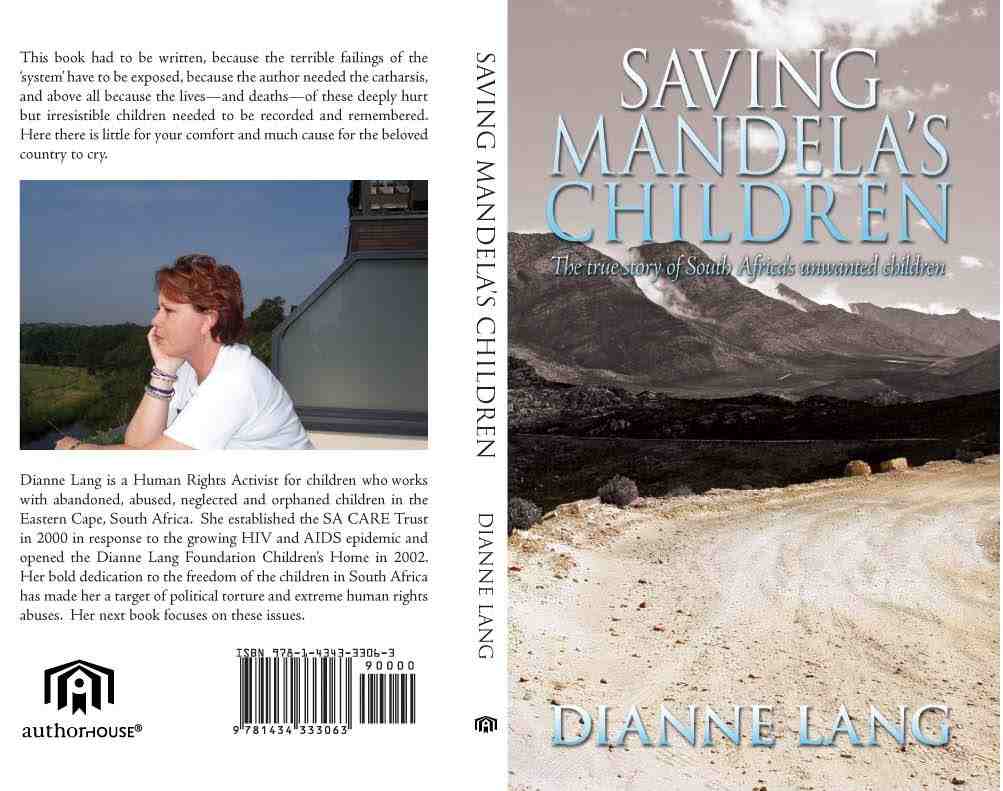
  An extract from Saving Mandela’s Children written by Dianne Lang and available on Kindle and Amazon and Authorhouse Pulishers.

Friday, April 4, 2014

Burying our baby!

Catholic Church from where Luke was buried

I had never had to bury someone before so I was learning the steps as I was going along.  There was much to organize to bury Luke.   There was a coffin to buy, a plot to purchase, and a funeral to organize.   Amore and I went off to the funeral parlor to discuss the
cost of a funeral and realized that we could not afford it at all.  When I told them that we would bury Luke ourselves we were promptly told that we would not be allowed to do that because we would not be given a death certificate.  “Thank you very much”, I said as we sailed out of the funeral parlor.  By this stage, I did not trust anything anyone in Middelburg told me and this smelled like a racket to me.   Was this a way to get poor people locked into expensive funerals?   Where were our constitutional rights?   Now I needed to go back to my books and back to the telephone to find out how to go about getting a death certificate without going through funeral parlors. 

After numerous telephone calls I discovered that the death certificate story that I had been given was a scam that all the funeral parlous were using to ensure that they got all the business.   No wonder no one buried their own family.   All I had to do was go to the police station and get a burial order.  It was that simple.   Next was the purchase of a coffin.   We went to three funeral parlous to find the cheapest coffin.  They were all out of our price range, although at that point, any coffin was out of our price range.   We were struggling to keep food on the table and had not paid the school fees yet.   The end of the month was coming up and staff salaries had to be paid.  On top of that, it was only two months to Christmas.   Eventually, I asked a funeral parlor if they did not have a damaged coffin or one lying around that could not be sold that we could repair.   The lady obviously took pity on us and went out into the back yard to take a look.   She came back with a little white coffin that was damaged and falling apart.   It was dirty and weathered from lying outside, obviously exposed to the elements for a long time.   “Perfect”, I said, “how much?”  “What about R100?”   The deal was made and we left with the coffin.   Amore was still so afraid of death or anything connected to it that she would not even carry the coffin.  With bravado, I picked it up and carried it across the street and put it into the 4 x 4.    With a little bit of paint, nails and screws, the coffin looked much better.   The children painted pictures on the coffin and it looked quite festive: a sarcophagus fit for a boy prince.

All the preparations for Luke’s funeral kept us busy and focused, and I had little time for grief.   There was much consternation at the staff meeting as they were very unhappy about us having a funeral and not using a funeral parlor.  “What will the community think of us?   They will think we are poor and will look down on us.   It is our culture to use funeral parlors.   We must also provide food for everyone who attends the funeral and there will be lots who will come because they want to see what goes on in the Children’s Home.  We must also have all the dishes outside so that after the service at the grave, everyone can wash their hands before coming inside”.   These were the arguments that they were giving me.   One of the many problems that have frustrated me over the years of working in the community has been the use of the word culture.   Having grown up in the Transkei, I know the customs and culture of the Xhosa people.   Using funeral parlors was definitely not part of the culture.   My mind wandered back to a workshop that I had taught where I had used an example of the necessity of using a seat belt in a car.   One of the delegates told me that he would not use a seat belt because it was not part of his culture.   “And using a vehicle is not part of your culture either.   You should be riding a horse”, I retorted.   The delegates howled with laughter.  I have found that many people use the word “culture” as an excuse for doing or not doing something.  Culture is also often used as another word for racism.  And the annoying thing is that those who use this word so indiscriminately are those who have never grown up in a tribal system, but have grown up in cities and in a western environment.   What they knew about tribal culture was dangerous.  It was time for a serious talk to the staff regarding more than just culture and funeral arrangements.   I needed to impress on them once and for all the dire financial situation we were in.   For some reason, they were under the impression that I was a never-ending source and supply of all things, because whenever we needed something, I always seemed to come up with what it was we needed, when we needed it.   However, it was more due to providence and good fortune that we always seemed to just make it. 

I brought out our bank statement and showed them that we had a total of R1800,19 in the bank.  I showed them my private banking account with an overdraft of R50 000,00 which had been keeping us afloat.   I showed them the total monthly expenses.   Not all of them grasped the seriousness of the situation, but they took it that I was not a never-ending supply of money and that I did not have any money to spare.   I also had to tell them that I had sold my own home in Port Elizabeth and that all the proceeds of the sale of the home had gone into keeping us afloat.  I had no other means of getting more money into our project.    “Funeral parlors are not part of the custom”, I said, while Nonqaba agreed by saying “Ewe, njalo”, “Yes, that is true”.  She is the only staff member who had grown up in the Transkei and, being the oldest member of staff, everyone had to concede to her superior knowledge.  I continued, “What we are going to do is bury Luke ourselves.   The community did not care for him.   They did not step in and offer any help.   They have not assisted us in any way at all.   In fact, no one did anything for the children before we came here and we are not here to put on any show for anyone.   Apart from trying to locate Luke’s mother to get her to attend, we are not advertising this funeral.   If we had money we would have been able to buy the drugs for Luke and he would not be dead.   We do not have the money for a big funeral.   We will do what we can with what we have.  There will be no more talking about big funerals”.

After more discussions, it was decided to have a short service at the Catholic Church and then we would walk to the nearest cemetery where we would bury Luke.   After that, we would come home and have lunch and then have a video afternoon for the rest of the children.   Organizing the church service with Father John was just a phone call.  Organizing the grave site was another matter altogether.

To purchase a burial plot, I had to go to the Municipal Health Department.   Amore and Jackson came with me.   Jackson was one of the first HIV and AIDS Trainers that I had trained, and he had been a volunteer for a long time before he joined me in caring for the children.   I asked them for a burial plot for a baby.   “That will cost R60,00”.   “That’s fine.   Is that in the town cemetery?”, I asked.  “What color is the baby?”   “What difference does that make?”   I was shocked by the question.   “The town cemetery is for whites only”.   “What?”   I was incredulous.  

Here we were, almost 10 years into the new South Africa, and we were still talking about cemeteries for white people.   Had Middelburg not heard that there had been a takeover by the ANC?   And that apartheid was gone?   “It is a white cemetery”, the lady behind the desk said again.   I had wanted to bury Luke in the town cemetery because it was the nearest cemetery to where we lived.   We only had one vehicle which could carry eight children at a push, and therefore everything we did outside the home had to be within walking distance.   The other two cemeteries were too far away for the smaller children to walk to.   During the previous government,  one cemetery had been for blacks, one for whites, and the third for coloured people.   The only reason I had chosen the “white” cemetery was because it was closest to where we lived.  Now, the cemetery became an issue for me.  It had to be that particular cemetery, not because it was the closest one anymore, but because I was told that it was a white cemetery and Luke was a black baby and he could not be buried there.  Was this another one of the new South Africa’s sick jokes?

“That is bullshit, utter bullshit.   This is the new South Africa.  There is no such thing as a white cemetery.  I want a plot in that cemetery and I don’t care what you have to do to get it for me.   You had better pick up that phone and phone your superiors and clear it with them now because I am not walking out of here until you give me the receipt that I have paid for a plot in the white cemetery for my black baby”.   My voice was raised and those waiting around to be served had stopped talking and were waiting to hear what would happen next.   Amore was pulling me by the arm and telling me to calm down.   Jackson was standing there with his chest stuck out a mile, looking pleased as punch and strutting around while bending his head in my direction every now and then when someone looked in my direction.   Jackson is one of my biggest fans, and he loves it when I get mad and give the authorities hell on some human rights issue.   This was just up his alley.   The little lady behind the window at the desk was busy on the telephone.   Comments started being made by those waiting to see various people in the department.   “She will never get a plot in the white cemetery”   “Yes, she will.   You watch and see”, said Jackson.   Other comments were made and Jackson was strutting his stuff, proud as punch to be the center of attention.   I was shaking with anger.   Amore kept rubbing my arm up and down and telling me “Calm down Mom”, but I was beyond being calmed down.    The lady came back to the office window.  “This has never been done before.   I can’t get hold of anyone”.   “If it has not been done before, it does not mean it cannot be done now.   Either you sell me that plot in the town cemetery or you get hold of someone who will authorize you to do so.   I have told you that I will not leave here until you do so”, I repeated.   Back she went to the telephone, this time clearly flustered.   The consternation that was going on in the Health Department had drawn other staff members into the office behind the glass window and they too were having their comments and opinions.    In the meantime, I remembered that I had the telephone number of Mr Kelvin Claasen, Head of the Health Department in Cradock and called him.  “Kelvin, this is Dianne.  I have a problem here.   One of my children has died and your department won’t let me bury him in the white cemetery.  I thought this apartheid bullshit was over.   Can you please tell them to cut their crap and give me a plot?”   I banged on the window and handed my mobile through to the lady.    “Here, take this call.   It is Mr Claasen”.   I watched her face.   She said nothing.  She nodded, and then nodded some more.   Then she said “Yes, Mr Claasen”.   And that was it.   “The plot will cost you R285,00” she said.   “Why
does it cost more than the original quote?”   “Because you want a white cemetery”, she replied.  “This too is utter bullshit.  The white cemetery costs more than the black cemetery?  Does the ground cost more?” I asked as I paid.   “Will the Health Department dig the grave?”, I asked.  “No”, she fumed.  “OK, we will do it ourselves.   Thank you for all your help”, I said sarcastically as we left.   Jackson was in his element.   As we went through the door, Jackson could not help himself.  He had to put his head back in to say “I told you so” to the gathered audience.

We woke up to a perfectly brilliant sunshine day: a perfect day for digging a grave.   Surely not such a big job for Jackson, Amore, the kids and I?   We had a pick and two spades so it would be fairly easy.   It had to be done today because the funeral was tomorrow.   We would cover the grave overnight with plastic, just in case it rained.    Just after noon, the three of us took the plastic, pick, spades and water bottles and went to the cemetery.   We found the grave site fairly easily.   The Department of Health had drawn an outline of the size of the grave into the hard earth.   Starting with the two spades, we dug around the marked areas.  This is where we encountered our first problem.  The earth was so hard that the spades bounced back up from the ground when we thrust them into the ground.   We tried jumping onto the spades so that the shock of the bouncing would be less on our arms.   When this seemed like a losing battle, we resorted to the pick.   Amore and I had tried the spades, so now it was Jackson’s turn with the pick.   He would pick at the earth and we would use the spades to move the earth out of the hole.  It was slow going.  Even the pick was making very little difference in the earth.  The sun was streaming down and in very little time, the sweat was pouring off of us and we were huffing and puffing.

An hour and a half had gone past and we had gone down 4 inches. We needed to get to five feet.   The earth was hard, dry clay.   We could not stop.   We took it in turns with the pick and the spade and made slow progress.  We stopped talking.   It was too hot and we
were too tired to talk.  We just wanted to get the job done.  The only sounds were the sounds of the pick and the spade on the hard baked earth and our panting.   There was not a breath of wind.   Three hours later, we were down to three feet, but now we could not use the pick.   The area of the small grave was too small to stand in and swing the pick.   It was spades only and we were getting nowhere.   “Let’s go and get the big boys to come and help us”, I said.   “What we need here are some metal tins to use to scrape the ground out and they will be small enough to get into the grave and do it”.   By now the wind had started to pick up and there were dark clouds brewing in the south, a sure sign of a summer storm.   We would have to move fast.

When Matthew, Mark, William and John arrived with their mbozo’s (tins), they got into the grave and started working on clearing the ground.   It was hard work for them as well.   We tried to stack all the ground that we were taking out up on the one side of the grave so that it would be easier to fill in after the burial.  This would also make it easier for us to get the coffin into the grave.   While they were working and we were encouraging them, the rain started coming down, so I rushed over to the van and got the plastic sheet.   We all huddled under the plastic sheet, the boys in the grave and the three adults sitting around it while the storm got worse and worse.   The wind buffeted the plastic sheet and it took all the adult strength to keep it from flying away.   As fast as the storm had arrived, it stopped.   Off came the plastic sheet and back to work we went.  

The cemetery is bordered by a well-used road that runs parallel with the fence and leads to the predominantly coloured area called Midros.   Seeing this group of blacks and only one white woman sparked something in the people who were driving past and they started shouting obscenities at us.   Some told us to get out of the white cemetery.  Whites drove past and shouted “Wat maak julle daar? Kom daar uit!” (What are you doing there? Get out of there!)    At three and a half feet, the rain came down in buckets again.   Again we sheltered under our plastic cover, but we were wet and cold.  

When the rain stopped, we would dig again.   And so the afternoon continued.   Digging, raining, sheltering, people shouting at us, digging, sheltering: it seemed never to stop.   “Will they know if we don’t dig all the way to five feet?” asked Amore.   “No, but I think we should continue”, I said, having visions of a flood and this coffin floating out of the ground.   This was the first grave I was digging and I did not want to get it wrong.   Looking back on this now, I wonder why I never doubted myself, what made me just go ahead as though nothing was impossible?  It was dark and still we had not reached five feet.   This called for torches, and so we continued to dig with tins while using torches to light our way.   Eventually we finished at about nine that night.    “I hope no one else dies because I am not digging any more graves”, said Matthew as we got home.   I hugged him and thought, “Yes boy, I hope we never have to dig another grave”.

The next day, I went to fetch Luke from the mortuary and Amore and I dressed him in “our” favorite clothes.  We wrapped him in his favorite blanket and put him in his specially designed coffin.  We all left for church at the same time, with Jackson carrying his coffin at the front of the line.  The children were all walking behind the coffin, walking slowly behind, two by two, holding hands.  After the service, we walked to the cemetery.   There were no other guests who attended.  It was only Luke’s family, us, we who loved him.

Luke’s funeral that day was simple, beautiful and a celebration of his life.   It was also a time to remember how grateful and honored we were to have loved Luke and to have been with him for those many months.   The funeral service at the Catholic Church was sad, with the children singing hymns.  I sobbed when they sang “Goodbye goodbye” to Luke.  I sat there remembering how Luke got one tooth at the bottom first, then one at the top.  Then he got another at the bottom and then another at the top.  He only ever had four front teeth.   He loved his milk biscuits and Vienna sausages.   He loved to be pushed around fast in his pram by the other children and squealed with delight when tickled.  We never did get to find his mother before he died, but heard later that she too was so ill that she would not have been able to come to Luke even had she wanted to.    

Luke’s mother died four months after Luke.   There was no money to bury her.   She lay in the municipal mortuary for five months before she was given a pauper’s funeral.

The smaller children still ask me when we go past the cemetery, “Mama D, can’t we wake Luke up now?  He has been sleeping long enough”.  They do not understand the concept of death.

The ‘white’ cemetery is no longer ‘white’.   Everyone can be buried under the beautiful trees in the most beautiful cemetery in Middelburg.  Many people of colour are buried there today.  I doubt if they spare a thought for the little black boy who was the first to lie amongst the fancy marble headstones of the apartheid whites only area: or a thought for the woman who fought so hard for that plot: or the rag tag band who dug the grave with jam tins. 

Renegade Angel

My precious children 


Renegade Angel – CARTE BLANCHE

Date : 20 February 2005
Producer : Kate Barry
Presenter : Devi Sankaree Govender
Genre : ChildrenAbuseSocial and Community

A drama workshop in the Eastern Cape town of Middelburg… These children may be dancing and singing, but each one has a painful history. To protect them, the law prohibits us from showing their faces

This is Mary. As a baby her prostitute mother locked her in a cupboard every day. She was placed with a foster mother, but when the childcare grant didn’t come, she was sold for R50.

This is Mary today: a happy toddler who lives in the Care House. The remarkable woman who rescued her and all the other children here is Dianne Lang.

Dianne Lang (SA Care Trust): “I know every one of them, I really know them. I know what their favourite colours are, I know their strengths, their weaknesses, the things that they like, the things they’re afraid of - I really know these children.”

There are 67 children in Dianne’s care. Their ages range from 18 months to 17 years. Most are HIV positive, many have been assaulted, some have been raped or sodomised - all were neglected. These children have become Dianne’s passion and life’s work.

Devi Sankaree-Govender (Carte Blanche presenter): “But when she first came to Middelburg, Dianne Lang had no intention of taking care of children. She was here as an HIV/Aids educator working with adults in the townships.”

Dianne: “My children were big. I thought, ‘Oh, this is wonderful! My 18 years of life sentence is over! I can do as I please.’”

But life is what happens when you’re making other plans. One night she was asked to look after three children found in a chicken coop.

Dianne: “There was Sam, who was three years old and dying of Aids, and really he was dying. The angel wings were flapping around this little boy. And there was Betty and she had been gang-raped.”

Devi: “How old was Betty?”

Dianne: “Ten. And then there was Patricia, she was about 11.”

Dianne says the social workers weren’t interested in the children.

Dianne: “They said, ‘This is the way they are in the townships. Lots of children live like that. So what?’ And at the time I was so naïve - I actually thought it was only those three. I didn’t realise that we had more than 350 children living like that here in Middelburg.”

The children had nowhere else to go.

Dianne: “If you have a dog and you can’t get rid of it and the alternative is to get the vet to put it down, you’ll keep the dog even if you don’t want it.”

Reluctantly she decided to keep them until they died.

Dianne: “But I started loving them. I started loving them, they crawled in my heart and in my skin and in my soul and when Sam stopped breathing, I grabbed him in my arms and I held him and said, ‘Sam, you have to live, you have to live’, and then I realised how much he meant to me. And he went like this [indicating] and he started to breathe… it was like God had given him back to me, and then I knew that I couldn’t turn back, they were mine.”

Sam is now seven and started school for the first time this year. And Dianne has many more children that she now calls her own, like three-year-old Donovan whom she found on the rubbish dump as a baby. He is just one of many children discarded by a town that is struggling to survive.

Middelburg is in the middle of the Karoo, 100kms from anywhere. What little work there was is drying up. The factories have closed, the trains have stopped running and the railway station stands empty. Even the municipality has closed down and moved to Cradock. In the townships there is no escape from the grinding poverty. On a Saturday afternoon almost everyone seems to be drinking.

Dianne: “You know what’s happening here - people are so poor, they’re dying so fast, you know, that the fabric of society is breaking down so badly that there are no norms and values anymore for these children. So brushing teeth, going to the toilet, these things are abnormal. Eating with a knife and fork or even eating off a plate is abnormal. Eating from a rubbish dump is normal. It’s normal to tease one another about how old was your rapist as opposed to my rapist. It’s normal to say, ‘I was raped six times. How many times were you raped?’”

Dianne and her staff try to give these children something resembling a normal family life. They cook four meals a day and, at lunchtime, all the street children in Middelburg are fed as well. This means they cook for over 120 people daily. The house is run according to strict rules: all the children have to make their beds and do the dishes. No stealing, lying or violence is allowed. Family members may visit children on Sunday afternoons under close supervision. Every child goes to school in the township and on Sunday mornings they all go to church.

Dianne: “We’re not eating grapes now, we’re going to church now, I told you! Come on - out, out , out! I-keps, I-keps.”

Dianne: “I decided we would try out a number of churches. We went to one church and then I found out that I wasn’t welcome. And then we’d go to another church and find out the children weren’t welcome. So it ended up that we started going to a Catholic church because it was the only place that we were welcome… and we were welcomed there because we were the only members of the congregation!”

Devi: “Dianne is single-minded in her cause and uncompromising in her stance. She confronts every obstacle head on and never backs down from a challenge. Not surprisingly, this sleepy Karoo town is struggling to cope with her.”

Johan Fourie (neighbour): “I don’t have a problem if they live here, but then they make a hell of a noise on a drum. When I go and talk to them about it, he says that it’s his culture to do it. What about my culture?”

Dianne: “I have brought the black children into the white area, so that is another concept that is difficult to swallow because one of the things is [that you hear people saying], ‘Hardloop’, ‘Gaan huistoe’, ‘Wat maak jy in die dorp?” [‘Run’, ‘Go home’, ‘What are you doing in town?’]

But that doesn’t mean she’s welcome in the township either. Being fluent in Xhosa, she is able to argue the point when drunken parents accuse her of stealing their children.

The last death at the Care House was in November 2003. Luke had full-blown AIDS and was only 18 months old when he died. Dianne wanted to bury him in the nearby cemetery and went to buy a plot at the municipality.

Dianne: “They said, ‘That baby you’re burying is black, this is a white cemetery’. I wanted the baby buried there, not because it was the closest cemetery, but because they said I couldn’t do it. I jumped up and down and I phoned Bisho and they very grudgingly gave me a plot.”

The children helped dig Luke’s grave, and today they can walk down the road to visit him there. Dianne sold her own house in Port Elizabeth and has bought five houses in Middelburg to house the children. It costs R50 0000 a month to look after them.

Devi: “Are you receiving any child care grants?”

Dianne: “No. I did apply to Social Development and they sent me a letter to tell me that they would not be funding me.”

Devi: “Why?”

Dianne: “They didn’t give a reason. Even the Nelson Mandela Children’s Fund say[s] they have no money.”

Devi: “So how are you managing to do this financially?”

Dianne: “Well, I had a beautiful house in Blue Horizon Bay on the beach. I had to sell that home to keep these children alive.”

Friends in Scotland send private donations and second-hand clothing for the children. And every few months she goes to the UK on lecture tours to raise money.

Dianne: “It’s not just the money thing, it’s the lack of care. The Constitution and the Child Care Act is there to protect the child but the people that are supposed to be administering it are not doing their jobs.”

If social workers think a child is in danger, they sign a Form 4 to put the child in a place of safety for 48 hours. Thereafter the court orders an investigation of the child’s circumstances.

Dianne: “In three-and-a-half years the system has only placed five… five, children permanently with me.”

Devi: “And the rest?”

Dianne: “They’re also still on Form 4s legally, a Form 4 stands for 60 days.”

André van der Lingen (lawyer): “When children are removed from their home and placed in an infant home for safety, then within a certain time prescribed by law, Social Services has to file a report in order for the court to ascertain whether the child is a child in need of care and has to be permanently placed in a place of care, and some of these reports have taken years.”

André van der Lingen is Dianne’s lawyer and is taking the government to court.

André: “It’s a specific order, it’s called a Mandamus Order - that’s an order obliging government to actually do what they have to do.”

Last year social workers removed 24 children from Dianne’s care, including this baby, and returned them to their abusive parents. Some were beaten again, before the police brought them back to the Care House. Dianne has decided that if the State won’t protect these children, then she will have to.

Dianne(cradling baby in her arms): “I’ll go to the Supreme Court this time because this is a contravention of the Child Care Act. This is a contravention of human rights, isn’t it?”

André is now launching a class action against the State on behalf of these children.

André: “In those cases we’ll have to approach the court and ask for a curator to be appointed and bring a class action for the damages that the children suffered as a cause of the abuse.”

Last week, while Dianne was celebrating her Woman of the Year award, events took an unexpected and tragic turn. Included in the class action were Lionel and Jonathan aged 14. While Dianne was overseas last year, social workers removed the two boys from the Care House and sent them to House Erica, a correctional facility in Port Elizabeth.

Dianne: “I got lots of letters from Jonathan, and I also phoned him a lot and he phoned me. I did know that he was being bullied. I took photographs of the boys. When they went to Erica, they had no tattoos. The boys told me that they were being bullied by the older boys - they were being held down, they were being tattooed, sexual advances were being made on them. They were also being exposed to drugs and so on, and they were not happy there.”

In his first letter Jonathan told her that one of their roommates had hanged himself on the stairs. Dianne did everything she could to get them out of House Erica and back home to Middelburg.

Dianne: “I have a file this thick. I’ve written letters to the Social Workers, to the Case Manager, to the District Manager, to Bisho, right up to the Minister of Social Development, to the Commissioner of Child Welfare, to the Department of Justice, to the Head of the Magistrates… every person who could possibly help in the case of Jonathan and Lionel, I have asked.”

But she got no answer. Jonathan and Lionel remained in House Erica and couldn’t go home to the woman they called Mama D, despite her promises to get them out.

Dianne: “A little boy who listens to somebody who says, ‘I’m going to get you out, I’m going to get you out’, is like promising someone, ‘I’m going to get you an ice cream,’ and it never comes - tomorrow never comes. So, for Jonathan, tomorrow never came.”

Last week Dianne received the news that Jonathan Kaptein hanged himself on the stairs. She went to Port Elizabeth to find out what made Jonathan take his own life. A representative from the Department of Social Services agreed to speak to us.

Alfrieda Mathews (Department of Social Services): “There was an incident regarding substance abuse, dagga, which they found in the premises of Erica House. The management stepped in, they confiscated the dagga, they did some investigation, they called the police and whatever. And apparently Jonathan was part of the group that was involved in this dagga, and some of the boys apparently accused him that it was his dagga. And, well, I think the boy took it too much and he decided that it’s got too much for him.”

Dianne: “I’m sorry! Not a small thing like that…not an intelligent boy like Jonathan.”

Dianne then went to the police mortuary to identify his body, and make arrangements to take him back to Middelburg to bury him.

Dianne: “The social workers on that case - and not only the individual social workers but all the way up - every single person I contacted right from the beginning until now needs to be held accountable. Anybody who could have done something needs to be held accountable.”

Alfrieda: “I would say that we did not fail, but there might be other reasons, emotional reasons, whereby the system may have failed him.”

Dianne: “If any one of those people had stopped and thought, ‘If this was my relative, if this was my child…’ If any one of them had done that, he would still be alive.”

Jonathan was buried yesterday in the Middelburg town cemetery.

Dianne: “I’m sad because I loved Jonathan. I’m sad because of the loss of potential… that Jonathon could have done something for our country. And I’ve been saying for so long that if we look after our children, we’re looking after our future. Jonathan was our future and because we didn’t look after our children, there’s part of our future gone. I’m actually passionate. If people… if there aren’t people like me out there, who’s going to speak for our children? Because nobody’s listening to them.”
IMPORTANT DISCLAIMER: While every attempt has been made to ensure this transcript or summary is accurate, Carte Blanche or its agents cannot be held liable for any claims arising out of inaccuracies caused by human error or electronic fault. This transcript was typed from a transcription recording unit and not from an original script, so due to the possibility of mishearing and the difficulty, in some cases, of identifying individual speakers, errors cannot be ruled out.  (Carte Blanche)

Sample chapter from...Saving Mandela's Children...by Dianne Lang

Dedicated to Amore Morgan 


I woke up with a jerk.   Someone was yelling.  

“Mama D.  Mama D.  Luke is getting bad.  Come quickly”.  

I jumped out of bed and ran down the passage.  Luke was ashen, lying with his big eyes looking at Amore as she held him.  Amore was one of the many young people that I had gathered around me during my life.  I always seemed to have with me a young person who was troubled.  She had come with me to Middelburg because she had problems with her family, and although she did not take Patience’s place, she did have a very special place in my heart. 

Luke had the most beautiful eyelashes and eyes I have ever seen on any child.   Luke was eighteen months old and dying of AIDS.   He had been living with us for almost ten months.   When his mother brought him to us to take care of, the doctor told us that he did not have long to live, and the best that we could do for him was to make him comfortable.  But we never believed doctors.   We lived as though there were no tomorrow.   Luke had been sick before and we had managed to get him well again.   He had even managed to go through the baby stages, getting teeth, sitting up, trying to stand and walk, all the things that he was not able to do when he arrived.   For some reason, we just all believed that Luke would be like all the rest.   He would just grow up and be like all the other kids.   Whenever the children got too sick, they would be brought into my bedroom and there they would stay until they were well enough to join the others.  When they got really ill, I would put their little bodies against my chest, wrap a baby blanket or towel around the two of us, and let the baby feel my heartbeat.  I would not put them down other than to change their nappies or to feed them, and then back they would go, tied to my chest.  And time and again, they would get better.

Now was the time for Luke to come to my bedroom.   When Luke became ill this time, Amore asked me if she could take care of him.  
I agreed, but I did warn her that it might be traumatic.   Amore was only twenty at the time.   She wanted to be with him 24 hours a day so that he would not be alone for one minute.  I agreed, as I would be there as well.  

Amore sat rigid in the chair, her eyes as wide as saucers.   I could see she was afraid that Luke might be dying and she was scared of death.  Luke was conscious but in pain.   His frail little body was sore and as I gently took him from her arms, he moaned faintly.   His breath was coming in short sharp intakes and the out breaths just left his chest without any effort on his part.   His heart was racing.  You could see how the artery was fluttering in his neck.  He was looking past me as though he was seeing something there that we could not see.   “He will not die now Amore, but Luke is dying”, I said gently.   I knew that there was nothing more we could do for our little boy.  He was beyond our help.  This time we would not be able to save our boy.  “Nooooo!!!”, she howled as she leaned over and put her head in her lap.  Her body shook with grief and her anguish poured out of her in great big sobs.  When Amore had calmed down a bit, I asked her, “Do you still want to be with Luke till the end?”   “Yes”.   “Then come”, I quietly encouraged her.   I called the staff and told them that Luke did not have long to live and they went to break the news to the other children.   The children were sad and crying, but they all came and said goodbye to Luke, some kissed him, others touched his forehead and others just stroked his little feet.   The staff stood around and said a prayer.   I called Father John and he came and baptized Luke and gave him the last rites.   Father John called me aside and said, “Dianne, you are forever calling me out to baptize your children at all hours of the day and night.  I think you should now do it yourself.   I can’t always be coming out, day and night, whenever you think one of your children is going to die and then they don’t.  All you have to do is say: “I baptize you in the Name of the Father, and of the Son and of the Holy Spirit”.  OK?”.  “Yes, Father, thank you for coming”, I said. We sent word out to try and find Luke’s mother, but she had gone to Cape Town.  Then Amore and I took Luke to a quiet place and sat with him.  

It took eighteen hours for Luke to die.  He never lost consciousness.   He was awake the whole time.  He suffered for eighteen hours.  His breathing became more and more erratic.   He could not swallow.  He could not pass urine.   He could not cough.  He would take a deep breath, exhale and then there would be no breath for a long time and then he would take another deep breath.   And so it would go on.    And on…and on...and on.   Amore grew tired.   I told her to go and have a sleep.  I would wake her if there was any change.   We were taking it in turns holding Luke in our arms, talking to him and singing to him all the time.   Amore curled up on the couch with a blanket and was soon fast asleep.   The emotions of the day were draining and she needed to rest.   Who knew when this would end?   In the stillness of the night, Luke’s breathing became more pronounced and his suffering became more evident.   I longed for the suffering to end.   This poor little mite was struggling to breathe for hour after hour.  I had already phoned the pharmacist and asked her if there was anything that would ease his suffering and she had told me that there was nothing.   I knew from experience that there was nothing at the hospital.   What could I do to help this little soul?   The minutes ticked by so slowly.   I kept looking at the clock.   How much longer does this have to go on?   I started to pray.  “Please God, stop this suffering.   Take this child into your care now.   This is enough.   Don’t let this carry on any longer.   Please don’t let him struggle for one more breath.   Just let him stop breathing”.  But no one heard.  The silence was made more deafening by the incessant struggle for the next breath from Luke.

OK, I thought.  I will do something now.  Amore is asleep.  No one will know what I am about to do.   I will take a pillow and put it over his mouth and then he will stop breathing and it will be over.   Not even God listens.   To allow this to carry on is beyond cruel.   I lean over and take the small pillow out of the pram.   I hold it up in my right hand.   Luke is lying in my left arm.   He has stopped breathing.   I don’t have to do it.   Thank you, God.   Then he struggles for the next breath.   I have to do it.   I hover with the pillow still in my hand.   I hesitate, knowing that I have no right to take another’s life, but at the same time consumed by the need to stop the suffering.   I
move the pillow closer to his head.  Closer still: the pillow is now just above his face.   And still I hesitate.   Do I or don’t I?   I need to stop his suffering.   I have an irresistible need to stop this awful breathing that is filling my brain and my mind and my soul with anguish and suffering from hell.  He looks at me.  Those big eyes of his look at me.   What is he trying to tell me?  Help me?  But how?  The pillow goes down on his face.   Gently.   My hand holds the pillow gently on his face.  I pull the pillow away from his face and fling it across the room.  I can’t do it.   I have failed him.   “Oh, Luke, my darling, darling little Luke, I am so sorry, boy.  I am so sorry I could not make you well.   I did my best, but you must go now my love.   Please go now.  Don’t stay any longer”.   “Amore”, I call, “wake up, and come and hold Luke”.   She stretches and comes over.  I put Luke into her arms.   He is still struggling to breathe.   I tell her to tell him it is OK for him to leave us now.  She does.   It is not long and she screams and throws Luke at me.   I catch him in my arms.   He has stopped breathing.   He will never breathe again.   Our baby is dead.

I phone the hospital and tell them that our baby is dead.   “What must I do?”, I ask.  “You must phone the police”, they tell me.  “Because if someone dies at home, it could mean that it is a homicide”.  I phone the police and tell them that our baby has died.  Two police officers arrive within minutes.  They call the mortuary van over the radio.  The mortuary man arrives and takes Luke.  He opens the back door of the mortuary van and wants to put our tiny little Luke into the back of the cavernous vehicle.  “Please can’t you take him in the front with you”, I beg.  “OK”, says the man, obviously seeing how distraught Amore and I are.  Luke leaves and our family mourns: the staff, the children, Amore, me.  For the rest of the night, I cradled Amore in my arms.  Little did we know what the next day would bring.

I had never had to bury someone before so I was learning the steps as I was going along.  There was much to organize to bury Luke.   There was a coffin to buy, a plot to purchase, and a funeral to organize.   Amore and I went off to the funeral parlor to discuss the
cost of a funeral and realized that we could not afford it at all.  When I told them that we would bury Luke ourselves we were promptly told that we would not be allowed to do that because we would not be given a death certificate.  “Thank you very much”, I said as we sailed out of the funeral parlor.  By this stage, I did not trust anything anyone in Middelburg told me and this smelled like a racket to me.   Was this a way to get poor people locked into expensive funerals?   Where were our constitutional rights?   Now I needed to go back to my books and back to the telephone to find out how to go about getting a death certificate without going through a funeral parlors. 

After numerous telephone calls I discovered that the death certificate story that I had been given was a scam that all the funeral parlous were using to ensure that they got all the business.   No wonder no one buried their own family.   All I had to do was go to the police station and get a burial order.  It was that simple.   Next was the purchase of a coffin.   We went to three funeral parlous to find the cheapest coffin.  They were all out of our price range, although at that point, any coffin was out of our price range.   We were struggling to keep food on the table and had not paid the school fees yet.   The end of the month was coming up and staff salaries had to be paid.  On top of that, it was only two months to Christmas.   Eventually, I asked a funeral parlor if they did not have a damaged coffin or one lying around that could not be sold that we could repair.   The lady obviously took pity on us and went out into the back yard to take a look.   She came back with a little white coffin that was damaged and falling apart.   It was dirty and weathered from lying outside, obviously exposed to the elements for a long time.   “Perfect”, I said, “how much?”  “What about R100?”   The deal was made and we left with the coffin.   Amore was still so afraid of death or anything connected to it that she would not even carry the coffin.  With bravado, I picked it up and carried it across the street and put it into the 4 x 4.    With a little bit of paint, nails and screws, the coffin looked much better.   The children painted pictures on the coffin and it looked quite festive: a sarcophagus fit for a boy prince.

All the preparations for Luke’s funeral kept us busy and focused, and I had little time for grief.   There was much consternation at the staff meeting as they were very unhappy about us having a funeral and not using a funeral parlor.  “What will the community think of us?   They will think we are poor and will look down on us.   It is our culture to use funeral parlors.   We must also provide food for everyone who attends the funeral and there will be lots who will come because they want to see what goes on in the Children’s Home.  We must also have all the dishes outside so that after the service at the grave, everyone can wash their hands before coming inside”.   These were the arguments that they were giving me.   One of the many problems that have frustrated me over the years of working in the community has been the use of the word culture.   Having grown up in the Transkei, I know the customs and culture of the Xhosa people.   Using funeral parlors was definitely not part of the culture.   My mind wandered back to a workshop that I had taught where I had used an example of the necessity of using a seat belt in a car.   One of the delegates told me that he would not use a seat belt because it was not part of his culture.   “And using a vehicle is not part of your culture either.   You should be riding a horse”, I retorted.   The delegates howled with laughter.  I have found that many people use the word “culture” as an excuse for doing or not doing something.  Culture is also often used as another word for racism.  And the annoying thing is that those who use this word so indiscriminately are those who have never grown up in a tribal system, but have grown up in cities and in a western environment.   What they knew about tribal culture was dangerous.  It was time for a serious talk to the staff regarding more than just culture and funeral arrangements.   I needed to impress on them once and for all the dire financial situation we were in.   For some reason, they were under the impression that I was a never-ending source and supply of all things, because whenever we needed something, I always seemed to come up with what it was we needed, when we needed it.   However, it was more due to providence and good fortune that we always seemed to just make it. 

I brought out our bank statement and showed them that we had a total of R1800,19 in the bank.  I showed them my private banking account with an overdraft of R50 000,00 which had been keeping us afloat.   I showed them the total monthly expenses.   Not all of them grasped the seriousness of the situation, but they took it that I was not a never-ending supply of money and that I did not have any money to spare.   I also had to tell them that I had sold my own home in Port Elizabeth and that all the proceeds of the sale of the home had gone into keeping us afloat.  I had no other means of getting more money into our project.    “Funeral parlors are not part of the custom”, I said, while Nonqaba agreed by saying “Ewe, njalo”, “Yes, that is true”.  She is the only staff member who had grown up in the Transkei and, being the oldest member of staff, everyone had to concede to her superior knowledge.  I continued, “What we are going to do is bury Luke ourselves.   The community did not care for him.   They did not step in and offer any help.   They have not assisted us in any way at all.   In fact, no one did anything for the children before we came here and we are not here to put on any show for anyone.   Apart from trying to locate Luke’s mother to get her to attend, we are not advertising this funeral.   If we had money we would have been able to buy the drugs for Luke and he would not be dead.   We do not have the money for a big funeral.   We will do what we can with what we have.  There will be no more talking about big funerals”.

After more discussions, it was decided to have a short service at the Catholic Church and then we would walk to the nearest cemetery where we would bury Luke.   After that, we would come home and have lunch and then have a video afternoon for the rest of the children.   Organizing the church service with Father John was just a phone call.  Organizing the grave site was another matter altogether.

To purchase a burial plot, I had to go to the Municipal Health Department.   Amore and Jackson came with me.   Jackson was one of the first HIV and AIDS Trainers that I had trained, and he had been a volunteer for a long time before he joined me in caring for the children.   I asked them for a burial plot for a baby.   “That will cost R60,00”.   “That’s fine.   Is that in the town cemetery?”, I asked.  “What color is the baby?”   “What difference does that make?”   I was shocked by the question.   “The town cemetery is for whites only”.   “What?”   I was incredulous.  

Here we were, almost 10 years into the new South Africa, and we were still talking about cemeteries for white people.   Had Middelburg not heard that there had been a takeover by the ANC?   And that apartheid was gone?   “It is a white cemetery”, the lady behind the desk said again.   I had wanted to bury Luke in the town cemetery because it was the nearest cemetery to where we lived.   We only had one vehicle which could carry eight children at a push, and therefore everything we did outside the home had to be within walking distance.   The other two cemeteries were too far away for the smaller children to walk to.   During the previous government,  one cemetery had been for blacks, one for whites, and the third for coloured people.   The only reason I had chosen the “white” cemetery was because it was closest to where we lived.  Now, the cemetery became an issue for me.  It had to be that particular cemetery, not because it was the closest one anymore, but because I was told that it was a white cemetery and Luke was a black baby and he could not be buried there.  Was this another one of the new South Africa’s sick jokes?

“That is bullshit, utter bullshit.   This is the new South Africa.  There is no such thing as a white cemetery.  I want a plot in that cemetery and I don’t care what you have to do to get it for me.   You had better pick up that phone and phone your superiors and clear it with them now because I am not walking out of here until you give me the receipt that I have paid for a plot in the white cemetery for my black baby”.   My voice was raised and those waiting around to be served had stopped talking and were waiting to hear what would happen next.   Amore was pulling me by the arm and telling me to calm down.   Jackson was standing there with his chest stuck out a mile, looking pleased as punch and strutting around while bending his head in my direction every now and then when someone looked in my direction.   Jackson is one of my biggest fans, and he loves it when I get mad and give the authorities hell on some human rights issue.   This was just up his alley.   The little lady behind the window at the desk was busy on the telephone.   Comments started being made by those waiting to see various people in the department.   “She will never get a plot in the white cemetery”   “Yes, she will.   You watch and see”, said Jackson.   Other comments were made and Jackson was strutting his stuff, proud as punch to be the center of attention.   I was shaking with anger.   Amore kept rubbing my arm up and down and telling me “Calm down Mom”, but I was beyond being calmed down.    The lady came back to the office window.  “This has never been done before.   I can’t get hold of anyone”.   “If it has not been done before, it does not mean it cannot be done now.   Either you sell me that plot in the town cemetery or you get hold of someone who will authorize you to do so.   I have told you that I will not leave here until you do so”, I repeated.   Back she went to the telephone, this time clearly flustered.   The consternation that was going on in the Health Department had drawn other staff members into the office behind the glass window and they too were having their comments and opinions.    In the meantime, I remembered that I had the telephone number of Mr Kelvin Claasen, Head of the Health Department in Cradock and called him.  “Kelvin, this is Dianne.  I have a problem here.   One of my children has died and your department won’t let me bury him in the white cemetery.  I thought this apartheid bullshit was over.   Can you please tell them to cut their crap and give me a plot?”   I banged on the window and handed my mobile through to the lady.    “Here, take this call.   It is Mr Claasen”.   I watched her face.   She said nothing.  She nodded, and then nodded some more.   Then she said “Yes, Mr Claasen”.   And that was it.   “The plot will cost you R285,00” she said.   “Why
does it cost more than the original quote?”   “Because you want a white cemetery”, she replied.  “This too is utter bullshit.  The white cemetery costs more than the black cemetery?  Does the ground cost more?” I asked as I paid.   “Will the Health Department dig the grave?”, I asked.  “No”, she fumed.  “OK, we will do it ourselves.   Thank you for all your help”, I said sarcastically as we left.   Jackson was in his element.   As we went through the door, Jackson could not help himself.  He had to put his head back in to say “I told you so” to the gathered audience.

We woke up to a perfectly brilliant sunshine day: a perfect day for digging a grave.   Surely not such a big job for Jackson, Amore, the kids and I?   We had a pick and two spades so it would be fairly easy.   It had to be done today because the funeral was tomorrow.   We would cover the grave overnight with plastic, just in case it rained.    Just after noon, the three of us took the plastic, pick, spades and water bottles and went to the cemetery.   We found the grave site fairly easily.   The Department of Health had drawn an outline of the size of the grave into the hard earth.   Starting with the two spades, we dug around the marked areas.   This is where we encountered our first problem.  The earth was so hard that the spades bounced back up from the ground when we thrust them into the ground.   We tried jumping onto the spades so that the shock of the bouncing would be less on our arms.   When this seemed like a losing battle, we resorted to the pick.   Amore and I had tried the spades, so now it was Jackson’s turn with the pick.   He would pick at the earth and we would use the spades to move the earth out of the hole.  It was slow going.  Even the pick was making very little difference in the earth.  The sun was streaming down and in very little time, the sweat was pouring off of us and we were huffing and puffing.

An hour and a half had gone past and we had gone down 4 inches. We needed to get to five feet.   The earth was hard, dry clay.   We could not stop.   We took it in turns with the pick and the spade and made slow progress.  We stopped talking.   It was too hot and we
were too tired to talk.  We just wanted to get the job done.  The only sounds were the sounds of the pick and the spade on the hard baked earth and our panting.   There was not a breath of wind.   Three hours later, we were down to three feet, but now we could not use the pick.   The area of the small grave was too small to stand in and swing the pick.   It was spades only and we were getting nowhere.   “Let’s go and get the big boys to come and help us”, I said.   “What we need here are some metal tins to use to scrape the ground out and they will be small enough to get into the grave and do it”.   By now the wind had started to pick up and there were dark clouds brewing in the south, a sure sign of a summer storm.   We would have to move fast.

When Matthew, Mark, William and John arrived with their mbozo’s (tins), they got into the grave and started working on clearing the ground.   It was hard work for them as well.   We tried to stack all the ground that we were taking out up on the one side of the grave so that it would be easier to fill in after the burial.  This would also make it easier for us to get the coffin into the grave.   While they were working and we were encouraging them, the rain started coming down, so I rushed over to the van and got the plastic sheet.   We all huddled under the plastic sheet, the boys in the grave and the three adults sitting around it while the storm got worse and worse.   The wind buffeted the plastic sheet and it took all the adult strength to keep it from flying away.   As fast as the storm had arrived, it stopped.   Off came the plastic sheet and back to work we went.  

The cemetery is bordered by a well-used road that runs parallel with the fence and leads to the predominantly coloured area called Midros.   Seeing this group of blacks and only one white woman sparked something in the people who were driving past and they started shouting obscenities at us.   Some told us to get out of the white cemetery.  Whites drove past and shouted “Wat maak julle daar? Kom daar uit!” (What are you doing there? Get out of there!)    At three and a half feet, the rain came down in buckets again.   Again we sheltered under our plastic cover, but we were wet and cold.  

When the rain stopped, we would dig again.   And so the afternoon continued.   Digging, raining, sheltering, people shouting at us, digging, sheltering: it seemed never to stop.   “Will they know if we don’t dig all the way to five feet?” asked Amore.   “No, but I think we should continue”, I said, having visions of a flood and this coffin floating out of the ground.   This was the first grave I was digging and I did not want to get it wrong.   Looking back on this now, I wonder why I never doubted myself, what made me just go ahead as though nothing was impossible?  It was dark and still we had not reached five feet.   This called for torches, and so we continued to dig with tins while using torches to light our way.   Eventually we finished at about nine that night.    “I hope no one else dies because I am not digging any more graves”, said Matthew as we got home.   I hugged him and thought, “Yes boy, I hope we never have to dig another grave”.

The next day, I went to fetch Luke from the mortuary and Amore and I dressed him in “our” favorite clothes.  We wrapped him in his favorite blanket and put him in his specially designed coffin.  We all left for church at the same time, with Jackson carrying his coffin at the front of the line.  The children were all walking behind the coffin, walking slowly behind, two by two, holding hands.  After the service, we walked to the cemetery.   There were no other guests who attended.  It was only Luke’s family, us, we who loved him.

Luke’s funeral that day was simple, beautiful and a celebration of his life.   It was also a time to remember how grateful and honoured we were to have loved Luke and to have been with him for those many months.   The funeral service at the Catholic Church was sad, with the children singing hymns.  I sobbed when they sang “Goodbye goodbye” to Luke.  I sat there remembering how Luke got one tooth at the bottom first, then one at the top.  Then he got another at the bottom and then another at the top.  He only ever had four front teeth.   He loved his milk biscuits and Vienna sausages.   He loved to be pushed around fast in his pram by the other children and squealed with delight when tickled.  We never did get to find his mother before he died, but heard later that she too was so ill that she would not have been able to come to Luke even had she wanted to.    

Luke’s mother died four months after Luke.   There was no money to bury her.   She lay in the municipal mortuary for five months before she was given a pauper’s funeral.

The smaller children still ask me when we go past the cemetery, “Mama D, can’t we wake Luke up now?  He has been sleeping long enough”.  They do not understand the concept of death.

The ‘white’ cemetery is no longer ‘white’.   Everyone can be buried under the beautiful trees in the most beautiful cemetery in Middelburg.  Many people of colour are buried there today.  I doubt if they spare a thought for the little black boy who was the first to lie amongst the fancy marble headstones of the apartheid whites only area: or a thought for the woman who fought so hard for that plot: or the rag tag band who dug the grave with jam tins.