Shaun And Kelly's Story
 |
| Kelly |
 |
| Gigi/Shaun |
I am so tired. The tears sting my eyes as I struggle to open the padlock on the security door and then open the locked door while balancing the files of court documents in one arm and my bag in the other. How many times do I have to bend down and look a child in the eyes and say “I love you still”, and then prize their little arms from around my legs or waist while they are being pulled away from me by an abusive parent, a family member, a stranger or a social worker?
Another day in court. Another child I could not save. Another court case where the outcome was a fait accompli. The child’s fate was sealed before we even had a chance.
I lock the doors behind me, put the kettle on, make a cup of coffee and flop down on the couch. The tears slowly flow down my cheeks and before I realize it I am howling. Great big sobs are forcing their way out from deep within my chest. I am struggling to breathe. I am drowning in my grief. My mind is numb. I cannot think coherently anymore. My thoughts are with the children that have been taken away and then with my pain and then fly to what my mother said. “Dianne, you are farting against thunder”. Perhaps she is right. No matter what I do, no matter how hard I try, no matter how much I love, I can’t seem to make the social workers or the Commissioner of Child Welfare understand that the interests of the children come first. And I hear my own voice howling in the emptiness and silence and wonder if that is really me. Have I become insane? Have I finally and truly lost it? Is this the moment that I give up and leave it all behind?
I struggle to bring my breathing under control and to stop the hideous howling that is coming out of my mouth. I grab a tissue and wipe the snot and tears away and look at the horrible distorted face staring back at me from the mirror. The vision staring back at me makes me start crying all over again, and now I can’t stop. I lie down on the couch and bury my head in a pillow and sob until I fall asleep.
I wake up hours later, cold and disorientated. And then I remember.
I found nine year old Kelly one ice-cold winter’s night in May 2002 in Lusaka Eastern Cape , and is the oldest township in South Africa
Kelly was sitting with her seven year-old friend, Jane, in what would serve as a street, which is nothing more that a strip of gravel between dwellings. They had covered themselves with a piece of cardboard to keep themselves warm. Kelly was dressed in a tracksuit top that only reached her elbows and had on a pair of track pants that reached her knees. Jane had a school dress on. Neither girl had any underwear nor had they shoes. Kelly had a very large scar running along her face where she had been stabbed by a youth in the township when she had been gang raped.
Both girls had lice and scabies. Both had been raped. Neither girl had had anything to eat in four days. Their last meal had been on the rubbish dump, the place known to the street children as “The Restaurant”. They had also never attended school. I reported the child abuse and rape to the police and a docket was opened.
Within weeks of the arrival of the girls, they too settled in with the other children, and were clean, healthy, happy, and attending school. But, as with all children who have lived on the street and who have been subjected to such a cruel upbringing, it is not easy to adjust to living in a house with others and it is not easy for others who are now socialized to live with such children.
Children who have lived on the street and who have been subjected to abuse do not know how to eat with a knife and fork nor to eat from a plate. They are used to scraping food from pots or plastic bags or off the street with their fingers. Kelly told me how she used to scrape the banana skins off the tar road after a car had ridden over them. They have never used a tooth brush or a toilet and have no idea of how to use toilet paper. They do not know how to blow their noses. They have to be taught how to get dressed, irrespective of their age, because they have never had any other clothes other than the ones they have on, so therefore have never had to take them off to put others on. Bathing is a major problem and struggle, as they want to bathe or shower with their clothes on. They do not understand that they have their own shoes and cannot just wear anyone’s shoes, so this also causes consternation with the other children when new children come in.
Children are renowned for teasing one another, but it is a tragedy that these children tease one another in this way: “The man that raped you was a grandfather but the one that raped me was young”. It soon came to our notice that Kelly, Lindelwa and Evelyn, three of our young children, had all been raped by the same man. This man is still walking around in the town, despite it being reported to the police and dockets being opened for all three offences. In the case of Evelyn, three male police came to take the statement from her. She told her story up until the point of the rape and then she refused to continue speaking. I then requested the police to send a female detective to take her statement. No female detective was ever sent. In the case of Kelly, no detective ever came to take a statement; and in the case of Lindelwa, she told her entire story to all three male detectives, which I thought was very brave for an eleven year-old girl. She also mentioned the name of her rapist as well as the address at which he stayed. The dockets went to the Public Prosecutor but he refused to prosecute. When I requested reasons for refusal to prosecute, it was stated that there was insufficient evidence, and that the problem had been socially taken care of since the children were now in my care. I have written to the Head of Public Prosecutions requesting an investigation into the reasons why it was thought there was insufficient evidence. Surely the police investigated the cases thoroughly, since rape is a serious offence and three children identified the same man as the rapist?
The children also play-act their rapes and sodomies for months after coming into care. Often, too, the children will use sticks or toothbrush ends to stick into their vaginas and anuses to show one another what has been done to them. It takes a lot of patience and counseling to get the children past their sex games and to the point where they realize that what has been done to them is not normal living.
As time passed, Kelly and Jane became more and more settled in and socialized with the large family that we had become. They were happy and carefree children.
One late afternoon in August 2002, a little squint-eyed boy who I had often seen with a group of street boys came to see me. He told me that he wanted to come and live with me. “Mama D”, he said, “I am tired of living on the street and since you are looking after my sister, it is my right to live with you”. It turned out that his sister was Kelly. The little boy was 10 year old Shaun, or Gigi, as he was known in the township. Shaun was on the Department of Social Development Register so I made the necessary enquiries and was told that there was no problem with the child living with me.
By the time Shaun came to live with us, there were thirty-four of us. Shaun was clever, witty, smart and loveable. He was also a talented gumboot dancer. The gumboot dance is the dance that the men on the mines in South Africa
I remember how Kelly grew from the frightened, abandoned, emotionally damaged child she was to the confident and child she became, the child with courage, determination and the beautiful smile. I remember the pranks and the compassion that Shaun showed at all times, the spirit of survival that he showed, his enthusiasm for life. I remembered the laughter, the love and the joy of our family being together and the security we all shared in being together. And I remembered with disbelief the telephone call I received yesterday the Social Worker, Pumza Mobo, to tell me that I was to bring Kelly and Shaun to the Magistrate’s Court because their aunt was going to foster the children. I relive it in my mind. “What aunt?”, I ask. “Their mother’s cousin’s sister”, she said. “Have you investigated and done the report?”, I asked. “Yes”. “What are the circumstances?”, I asked. “She lives alone and is willing to care for the children”, she tells me. “But where has this aunt been for the past three years?”, I ask. Silence. “Be at court at 7h45”, the social worker tells me, “and don’t forget to bring the children”. The time is 16h30. The offices of the Department of Social Development close at 16h30. I have no time to argue the case or do anything about what is going to happen. Pumza Mobo has timed this perfectly to her advantage.
I go down to the children’s house. I call Kelly and Shaun and tell them that we have to go to court tomorrow and that their aunt wants them to go and live with her. I ask them if they are happy about that. They are not. They say they will go for the weekend but not forever. I tell them that family is better than staying in a children’s home forever, but I will try and speak to the magistrate to get him to let them stay a while longer or let them come home to me for weekends. I try and get them prepared in case things do not go according to what they want, and for that matter, according to what I want.
The Department of Social Development has a mandate that all children are to be re-unified with family as soon as possible after being removed from their home. In Kelly and Shaun’s case, they were not removed from their home, but from the street. Re-unification also means that the child or children are given a period of adjustment, so that they get used to their new family circumstances and that there is as little trauma associated with the move to their new environment as possible.
We are at court at 7h45. Kelly and Shaun are holding tightly onto my hands. The social worker and Trudie, the nursery school teacher, are there. I look around for someone else. I ask the social
worker where the aunt is. She points to Trudie. I gasp. I am shocked. I cannot believe what I am seeing or hearing. Something cannot be right. Every day I see Trudie. She has not mentioned that she is the aunt of the children. She has never visited the children. The children have not mentioned her, nor have they ever made any fuss of her. What is going on here? “What is going on here, Trudie?”, I ask. “If you wanted the children, why did you not discuss it with me?”, I question her. “Pumza told me to take the children and I assumed you knew about it”, she said, indicating the social worker. Just then, we are called into the court room.
The magistrate, who now assumes the position of Commissioner of Child Welfare, looks at all the papers, asks the “aunt” if she is willing to take the children, then asks the social worker if she is happy and when he gets the affirmative starts making out the order. I attempt to make myself heard by telling the Commissioner that the children have been with me for three years, that they need a period of adjustment before the final move, and that I have not been given a chance to see the report. He tells me that children need to be with their families and that is all that matters. With that, the order is signed and we are dismissed. I am shocked. Thoughts run through my head. I want to shout out loud that it is all a set up. That if the social worker was not sleeping with the Commissioner of Child Welfare, maybe the children’s rights would be observed!!!! In whose interest was the order made out? We walk out and the children cling to me. I ask the aunt to please let the children visit and then she and the social worker start pulling them away from me and put them into the social worker’s car. I stand on the court house steps and watch the car drive away, the children’s faces awash with tears, pressed up against the windows of the car.
I get up and wash my face. I am no longer so cold and disorientated. I have had a cup of coffee but I need to talk. I need to be with other human beings who care. I need to talk to Nonqaba. I put on a jacket and walk down the road. Three houses of children in the same street, but this evening the sound is muted. There is a sadness hanging over all the homes. Shaun and Kelly are gone. I remember overhearing Shaun telling some of the other children one day, “Life is better when she is around”, pointing over his shoulder at me. They were part of the family. I must remember to tell the children that although these two are gone, they are not dead, not like the others.
I fall into Nonqaba’s arms. I can see she has been crying too. But her tears are of anger. “That woman is not the children’s aunt! And she has already got 8 children that she is fostering. She only does this to get the foster-care money”, said Nonqaba, clearly angry and agitated. “I am going to see that Pumza Mobo, she is a liar. I don’t know what she is trying to do with this community”, she continued.
The situation regarding the two children was worse that I thought. Not only were they suddenly uprooted from a place where they were safe and happy with no preparation for the move, but now they were in a place where they were not with family as they were led to believe, but with a group of children. Kelly is now living in the same township where her rapist is still walking free. The interest of the child was clearly not a priority. The priority was foster-care grant for the foster mother, and an easy solution for the social worker whose mandate was to ensure that as many children were removed from my care as possible, regardless of where and how they are placed. Section 28 (2) of the Constitution states: A child’s best interests are of paramount importance in every matter concerning the child. What does this really mean to the child? It may as well not exist as far as the child is concerned, because in this case the child’s interests were clearly not taken into consideration and, in fact, the children’s rights were violated according to the constitution.
Nonqaba and I put the children to bed and when all was quiet, made a cup of tea and sat at the kitchen table, talking about the problems caused by the authorities. Why, when the authorities had no alternative to us, did they give us such a hard time? Why did they not want to assist us with what we were doing? Why would they not work with us? After all, these children belonged to all of us. They were the thrown away children of the community. We did not receive any grants for them. We did not take anything from the authorities. We were no threat to the social workers. Or were we? Were we showing them up by doing what we were doing? Were we doing what they were being paid to do and they were not doing it? Was it professional jealousy? We had tried attracting the bees with the honey. It had not worked. We were now standing up to them. We were studying the Child Care Act and the Constitution and using those when dealing with them, but even that did not always work. They would catch us off guard, like they did with Kelly and Shaun.
We had another problem. Shaun was part of the drama performance we were taking to the Grahamstown National Arts Festival. We had been practicing for weeks and the gumboot dancers’ performance was excellent. Their precision and synchronization was unbelievable for children of their age, and Shaun was an integral part of the performance. The venue had been booked and paid for, the accommodation had been booked and paid for, the advertising had been done and above all, Shaun was looking forward to the ten days of performing in Grahamstown. Now we would have to look at the whole play and try and get the boys to perform without one of the team. The welfare knew that Shaun was part of the team and that we were going to Grahamstown. No one from Middelburg had ever performed at the Grahamstown National Arts Festival before, and this was a really big event in all our lives. We were going to be performing against seven hundred other professional performances. How could that social worker do this to us, and more specifically, to Shaun? Did she not have any compassion, any vision, any thought for the future of the children? I left Nonqaba to go to bed, hoping that a new day would bring a new perspective on everything.
I did not have the energy to bath. I just lay on the bed. Despair was the only thing I felt. Total despair. Total exhaustion. Not depression. Despair. Depression is a sadness, one you can speak about, a condition that can be treated with medication. Despair is a dark pit in the mind from which there is no escape, no words to describe and no medication to relieve. No place to go. No way to turn. No way out. I think of death. I feel I cannot carry on. There seems no reason to take the children in, protect them, love them and to let them go the way Shaun and Kelly left today. I know what will happen to them. They will stop going to school. They will return to the streets. The foster care grant will be misused. It has happened hundreds of times before. What help did I really give to Kelly and Shaun? Would it not have been better to leave them on the street, because then they would have known no better? Perhaps they would have been dead, but now they were suffering indescribable heartache, the wrench from the safety of our home, the love, the security. What had I really achieved by taking them in for three years and loving them the way I had? I think of taking an overdose. But I don’t have the energy to get off the bed. I hope God will be kind enough not to let me wake up tomorrow.
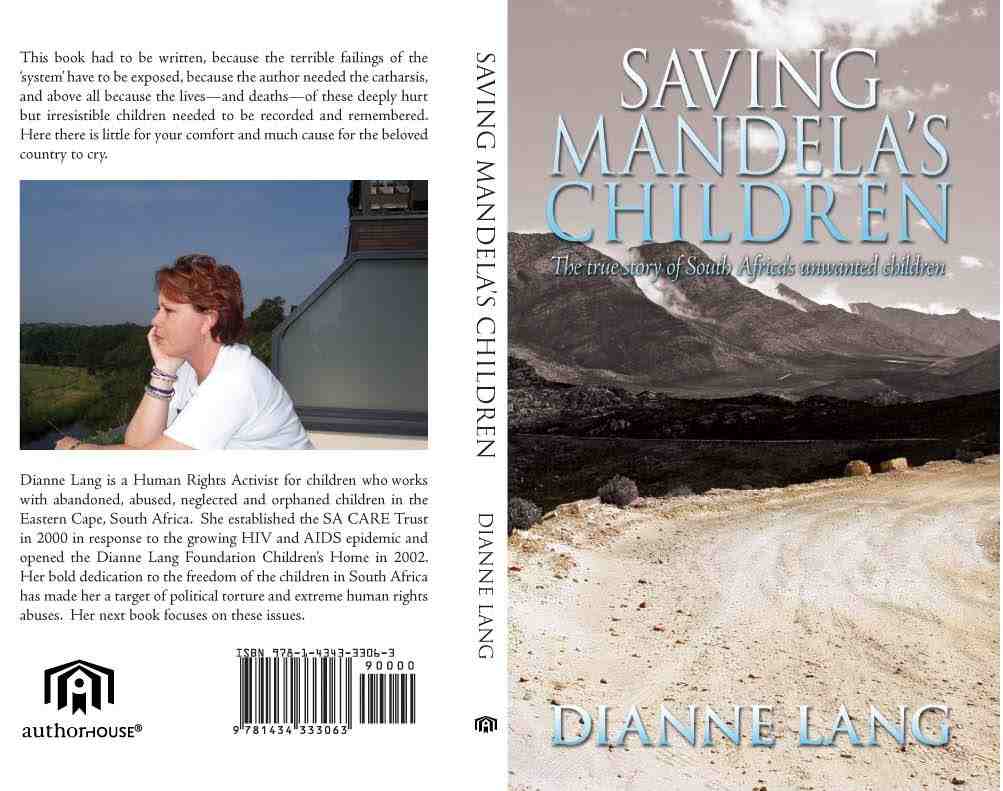
An extract from Saving Mandela’s Children written by Dianne Lang and available on Kindle and Amazon and Authorhouse Pulishers.


 Posts
Posts