Showing posts with label children. Show all posts

Thursday, October 13, 2016

How Corruption between Policemen and Scorpions ruined my life

My Children

(Written by Investigative journalist Jack London for Noseweek, March 2007. All writing between brackets is mine)
Dianne Lang, known with affection as “Mamma Dee” in the townships around a small Karoo town for her work with abandoned and “at risk” children, has fled the country, following a blitzkrieg of raids by the Scorpions investigating the alleged misappropriation of more than R1m of donor funds from her award-winning project.  Before she took off for London on 6 February, Dianne, who has not been charged, claimed that the elite crime-busting unit was set on her by a police inspector in the Great Karoo town of Middelburg – after she rejected him as a lover.
Noseweek has also unearthed disquieting evidence that officers from the Scorpions were involved in an unauthorised investigation at 50-year-old Dianne for a full year before the probe was officially sanctioned.  During this time, speculation about her pending arrest swirled around Middelburg, causing her eventually to flee the town, her reputation in tatters.
“I have not misappropriated funds nor have I taken money from the children”, she says now.  “But my reputation is gone: I am already considered a criminal.”
On 5 (6)December last year, (2006) in “Operation Dynamite”, Scorpions teams from Eastern Cape headquarters in East London swooped on eight premises in Middelburg and Port Elizabeth, removing computers and financial records of her SA Care Trust, which operates as the Dianne Lang Foundation.  The search and seizure warrants state that there is reasonable suspicion that theft and/or fraud, as well as money-laundering and/or racketeering in contravention of the Organized Crime Act, has been committed against SA Care Trust from the beginning of 2003.
The Scorpions’ operational head in Pretoria, deputy director David Demerell, tells Noseweek that he signed the authorisation for a preliminary investigation, called a Section 28 (13), in July or August last year.  However, a year previously – in August 2005 – Dianne was tipped off that she was being secretly investigated by the unit.
In the apartheid years Dianne Lang was a card-carrying member of the ANC and a Black Sash activist.  More lately she was a counselling psychologist in Port Elizabeth until she decided to launch her own fight against the Aids pandemic, with a support centre for HIV positive residents of the townships clustered around Middelburg.  The town (population 44 000) lies in the Sneeuberg mountain range in the Great Karoo, surrounded by sheep and game farms. “Everyone knows everyone or is related to them,” says a local.
With a R15 000 donation from Vodacom, Dianne bought a tumbledown house in the middle of town for a support centre.  One night in the middle of winter she found three children on her doorstep, two 10-year-olds who had been gang-raped and a desperately ill three-year-old.  When she took them to the local offices of the department of social development she was told:  “These are street children; put them back on the street”.
A doctor in town told her the children would all die soon of Aids.  “I thought, well, I’ll keep them till they die.  At least I’ll nurse them and they won’t die hungry, cold and alone”.

Thus Dianne’s epiphany became the district’s needy children – HIV positive or not.  She sold her house in Port Elizabeth’s Blue Horizon Bay and after paying off the bond used the balance for start-up funds.  Today 35 children live at Care House, looked after by a staff of seven, plus volunteers from America and the UK.
However, the arrival of black children at the project’s five houses in the mainly-white centre of town, plus her crusading style, made waves.  The wife of a prominent resident came to her door and told her: “I’ve just come to warn you that if you don’t get these kaffirs out of town, we’re going to burn your houses down”.
Relations with the local office of the Department of Social Development have never been smooth, either.  “They are totally incompetent and there is no service delivery from them,” says Dianne.  “I’ve been a pain in their side”.
It seems that things were looking up when police Inspector Louis Jenner arrived on the scene.  Jenner and his “van partner”, Inspector Wollie Meyer, are both area representatives of the SA Police Union, and figures to be reckoned with in this small community.  Jenner became chairperson of Care House’s house committee, and threw himself enthusiastically into his charitable duties.
Running Care House, says Dianne, costs about R70 000 to R80 000 per month.  International donors have rallied to the cause, the largest being the UK’s Grace Foundation, with an on-going contribution of £2500 (presently around R35 000 per month).  Every six months Dianne would set off for the UK, to raise more ever-needed funds through lecture tours.  One trip raised a record R100 000.
In 2005 her work with needy children was recognised when she won the Clarins Most Dynamisante Woman of the Year Award.  She handed the R150 000 prize money over for the children.   But 2005 also brought turmoil in Middelburg as her relationship with Inspector Louis Jenner soured.  On April 5 there was a stormy visit by Jenner to her house, and the following day Dianne appealed for help in a “confidential report” to Middelburg’s acting police commander, Captain Flip Meiring.
After Jenner became chairperson of her house committee, wrote Dianne, he became very involved with Care House.  “At first I thought this was because he was chairperson, but later it became obvious that this was an excuse to spend time in my company”.   “I very soon realised that I was not dealing with a normal case of love, but one of obsession.  He said he was in love with me and could not help it”.  When she remonstrated, Jenner would ”get mad and slam the door”.
During one of these outbursts Dianne told her suitor that she no longer wanted him in her house and suggested that he resign from the house committee.  “He told me I was a dishonest and despicable person and that I would pay for what I had done to him”.
She had already fallen out with Jenner’s “van partner” and fellow SA Police Union representative colleague, Inspector Wollie Meyer.  She had trained his brother Neil Meyer as a home-based care worker, but after a string of verbal and written warnings started in February 2005 (falsifying attendance record, physically punishing children, dereliction of duty, gross insubordination, etc.), Neil Meyer was dismissed after a disciplinary hearing on 12 September.
Between that July and September there were three mysterious burglaries in Middelburg – one at Dianne’s house and two at the Care House office.  At the office, computers were taken, as well as trust files.  In the last break-in, on 25 September, messages were scrawled on the wall: “watch out bitch”, “easy to kill you bitch” and so on.  The culprits were never found.  The day after the 17 September second break-in, Neil Meyer’s brother, InspectorWollie Meyer, was saying: “the computers are already in East London (the Scorpions’ regional HQ) and the shit’s going to hit the fan in Middelburg”.
Dianne first became aware of the Scorpions’ covert – and, we now discover, unauthorised – operation during August 2005, when she was called to the office of the headmaster of Middelburg’s VDM school, Edgar Williams.  In an affidavit, Dianne says the headmaster “informed me that Inspector TC (Wollie) Meyer has been to see him to tell him that I was under investigation by the Scorpions”.   Rumours of Dianne’s imminent arrest swept through town.  She stuck it out for a year until last August – the time the preliminary investigation was finally authorised – when she returned to Port Elizabeth, leaving the children of Care House under the collective wing of manager Diana Jagers and the rest of the team.
It was also last August that Dianne discovered who had put the Scorpions onto her.  On 22 August she attended a meeting with Advocate Dale Robinson of the National Prosecuting Authority in Grahamstown, to discuss the status of a case she had opened against Inspector Louis Jenner for assault and crimen injuria.   With her was a private detective, former police brigadier Charlie Kemp whom Dianne had hired to help her.   Says Kemp:  “Jenner had made a statement about the allegations made against him by Dianne.  Advocate Robinson read the statement to us and in it Jenner said he had reported her to the Scorpions for embezzling funds”.
Will Manual is the Scorpions’ East London-based investigating officer in Dianne’s case.  Manual declines to discuss the investigation and will only confirm:  “It’s ongoing”.
In Middleburg, Inspector Jenner, married and father of three, is reluctant to talk about Dianne Lang, other than to confirm that he fell out with her.  “She decided she wants to operate the Care House on her own,” he says.   Jenner denies it was he who made the complaint against Dianne to the Scorpions.  “No. Who says so? Who gave you that information?,” he demands.  “From your statement,” we reply.  “Where did you get that information from?”
Why are the Scorpions involved in this case at all, when the amount allegedly involved is apparently not much more than R1m?  The unit’s guidelines say that fraud and economic offences should generally exceed R10m before they get involved.  Deputy director David Demerell explains that intake criteria may be relaxed when it comes to factors like international donor money and the poorest of the poor.  A fortnight before last December’s raids Demerell authorised the probe into Dianne to be upgraded to full Section 28 (1) status.
So what evidence has Will Manual and his colleagues at the Scorpions dug up on Dianne Lang?  A bunch of payments totalling more than R1m from the bank account of SA Care Trust into her personal account, we can reveal.  Dianne doesn’t deny it – and says there’s a simple explanation.  “I borrowed money on my overdraft and lent the foundation money.  Then when donations come in, I paid myself back.”

The trust’s unaudited accounts for the year ending 28 February 2005 – prepared by the Port Elizabeth accountancy firm of Buckingham and Associates – show that Dianne received a total salary that year of R35 000 (a frugal R2916 per month).  They also record that she was owed R418 778 for long-term loans.
Noseweek  has established that in July 2005, after a welcome R75 000 donation from “PNP Golf Day”, the trust’s bank balance stood at R288 925.  This, however, was depleted by a whopping R200 000 paid to Dianne in two amounts of R100 000 – on 26 July and 13 September – leaving the trust, after other minor disbursements, with just R78 966,78. (These payments were for personal loans to the trust).
Around that time Dianne’s managing director’s salary was increased to R16 000 per month – the amount she’s still drawing to this day.  SA Care Trust’s trustee and bookkeeper, Port Elizabeth businessman Stuart Irvine, says: “Since 2003 the trust has received in excess of R1m from Dianne in loans that she raised through her overdraft and house loan.  These have been repaid to her when we have funds.  She’s still owed more that R200 000.
At Buckingham & Associates, the Scorpions removed financial records and a computer as the firm’s Christine Hickman was finishing the trust’s 2006 accounts.  “I gave them a good dressing down,” says Hickman.  “They think Dianne’s embezzling funds, which is absolutely ridiculous”.
Vodacom and a Netherlands charity, Stichting Kinderpostzegels, have both withdrawn their support of SA Care Trust.  But the Grace Foundation’s £2500 per month is still trundling in.  And last November, a month before the raids, Dianne’s old enemy, the Department of Social Development, came up with a  one-off subsidy payment of R182 000.  (By this time Dianne was looking after 76 children)
SA Care Trust’s bank balance is now down to R70 000 – barely enough to get through last month.  “I’ve got to raise money, otherwise we’re going to close down,” says Dianne from the UK.   She plans to stay in London for at least a year.  “I feel despair: can I carry on any longer?  I feel anger: that the persons who have caused all this – and I know who they are – can get away with it.  I feel confusion: I know I was doing the right thing, saving the children, making a difference in their lives.  So why is it all so difficult?”
Down in Middleburg, plumber Hough Theron, who lives next door to Care House in Smid Street and takes its children fishing at nearby Grassridge dam, has a view on that.  “If Dianne hadn’t come in and made such a dramatic impact, perhaps people would have accepted her.  Her big mistake was to make an impact and they didn’t like that.  They said:  “For 10, 20, 30 years we’ve been doing it this way, why should we change?”   “Louis Jenner got absolutely carried away with her, but Dianne wasn’t interested at all”.

(On 17th December 2008, the Scorpions returned everything they had seized during their raid expect one computer and another computer was returned in pieces.  Together with the trust’s returned materials were the materials of two other companies which had obviously been under investigation.  One box of documents had gone mission.   A letter from the Scorpions admits to damaging the computers and makes a claim that when funds were available, the computers would be returned/replaced.  They would also look for the missing box of documents.  This never happened.   I believe that the severe stress I endured played a large part in my subsequent diagnosis of leukemia.  I have never been charged and I have never been notified of the outcome of the investigation.  However, the Scorpions inadvertently left the forensic audit amongst the returned documentation.  Over a five year period there was  R11.00 unaccounted for.  This could have been for anything from buy stamps and not recording it or giving children pocket money or money that they needed for school.   How much it cost the state to chase after me boggles the mind, but sadder still was the fate of the children.  They had lost their Mamma D and I had lost my children.  The home closed in 2010, leaving more than R400 000 in my loan account, when all the children were either returned to their parents, to foster parents or to the streets.  While many children have died during this time, many are now adults and we are still in contact.  A Christian group took over 7 foster children.  Will Manual is a private investigator, Jenner and Meyer have been promoted and Meiring has left the police force.  I was very traumatised by what had happened and this article is a very small part of what went down.  Amnesty International and the Helen Bamber Foundation for victims of political torture helped me to understand what had happened to me.  They also gave me insight into why the Scorpions behaved in the manner that they did.  It is all designed to put the “suspect” under extreme mental and emotional pressure.  I had not only lost all my money, but I had lost my sense of security and the foundation on which I had always lived.  The Helen Bamber Foundation  gave me back to me.  I have wanted to write the sequel to Saving Mandela’s Children, but the hurt is still fresh and I am not ready to go through the documentation to write another book of this nature just yet.)

Wednesday, August 31, 2016

OPERATION MPUKU - Open Letter to Authorities

Willem Basson
Environmental Health
Nelson Mandela Bay Municipality
Tel: 041 - 5065413
Cell: 0794900416
Re: Your previous email to me: Rodent Control Program in the area of Central.

My dear Mr Basson
I am in receipt of your email dated 30 August 2016 in which 23 people, of which only three I have copied in the mail, these being the Times Media news desk, the owner of the building I live in and the Mayor’s office, have been copied into the mail; the latter only because I was dealing with the Mayor’s office form the beginning.  I had no alternative to this because not one of your Metro departments answered telephone calls.  
The tone of your letter is disrespectful to say the least.  Calling me ignorant is highly disrespectful and unprofessional… because you do not know what knowledge I have, nor do you know the amount of research I have conducted into the rat epidemic, not only in the Metro but in all residential areas of South Africa.
For what reason the deaths and injuries caused by rats gets so little media attention, I can only speculate – the information is being suppressed for some or other reason.  The information would definitely be damaging to the tourism in our country.  This very email you have sent me is empirical evidence of a cover-up.  Either there is a cover-up by the South African government or you are totally inefficient and ineffectual in what you do at your Environmental Health Department, particularly with your Rodent Control.
I have not threatened you with the Mayor’s office – you are feeling threatened by my refusal to kowtow to anyone, and even less so with someone who is paid to do a job and is not doing it. My correspondence is obviously seen as a threat due to my researched knowledge of the subject at hand.  If you are feeling threatened by your own inadequacy, please don’t turn it around and make a comment like “Refrain from threatening me with the Mayor”.
Thank you for the following information – “The Plague Endemic area has been predetermined by the NDOH and the WHO”.    From previous correspondence this area is designated as Koega.  Because an area is designated a Plague Endemic Area does not mean that the area immediately adjacent to that area is safe from the threat of disease carrying rats which bite and cause the death of people.  Those who are particularly at risk are babies, the infirm and the prisoners. 
May I remind you that you do not work for the Mayor, but you work with the Mayor, and together the Metro Departments work for the people .  You are paid by our taxes. That is why you are called a civil servant.  You are a servant to the public.
I fully understand that the Mayor would not and should not go against National and International Law and Protocol.   However, you are simply not doing your job!  You are not in control the over-population of rats in our Metro.
“Seeing that you have picked up and “preserved” the dead rat which might have died from our rodenticides you may just as well throw it in the trash container.  Your one, (sic) dead rat is of no use to the disease preventative control program”.  This statement of yours is insolent and rude.  I again ask the question; Why would you not test this rat for diseases it may or may not be carrying?  It did not die from your ‘so called’ rodenticides, as you have stated.  It was very much alive, together with his family, in my kitchen.  Why would you be so unwilling to be open to the fact that your Plague Endemic area predermined by the NDOH and the WHO may need to be revised, since Koega is adjacent to the Metro?
As far as your NMMM Environmental Health sub-directorate having a “permanent, ongoing surveillance program is concerned, I can only say that the inspector from your department who came to do a site inspection said “Eyo…this is bad.  They must come and sort this out.  I will tell them”.
I understand that the last outbreak of the plague in this area was in 1981,    That statement is as crazy as saying all swans are white.  That is a guarantee of nothing.
I am particularly concerned about the number of babies, prisoners, the old and infirm people who are being bitten and have died from rat bites.  This over-population of rats the size of small cats has surely reached epidemic proportions.  May I add that the notorious “Central” area is part of the Heritage walk.   Our tourists will have rat companions walking alongside them as the rats are used to humans in their presence and do not run away.  They merely look at you and walk slowly on. 
You may say you have closed this case and you “shall not entertain your speculations any longer”.  My dear Mr Basson, I have not even started yet.  When our city and the cities and towns are cleared of disease carrying rodents, I will close the case.  I would just like to inform you that my particular home is now rodent free.  I am not doing this for my own benefit but for the benefit of all the peoples of our country.   For that reason, the case will not be closed, no matter what you say.
As opposed to your “THANX” at the end of your mail, I shall do it the right way.
Yours truly
Dianne Lang.


Thursday, December 31, 2015

Christmas Letter to My Children and Grandchildren

Christmas 2015

My precious Niki, Denny, Abbe, Cameron and Olivia

My greatest wish is that my children and grandchildren will always know just how much I love them and know just how proud I am of each.
My greatest desire is that for the rest of their lives they will know that no matter what, I will always be there for them, anyhow I can.
My children are my most precious assets and I will hold them gently and safely in my heart forever.
When I look into the eyes of my children’s children, I look into the face of God.
If there ever comes a day when we can’t be together, keep me in your heart and I’ll stay there forever. (Winnie the Pooh)
I love you with all my heart.  May you experience a beautiful Christmas and a year ahead that will give you enough of everything you need, with a little more so that you can give some away.

Your Mom /Mooms 

Monday, September 1, 2014

We are not born racist. Children identify with those who love them.

Volunteer Kathy 
Let me explain my simple view of racism.  I do not believe that we are born with it.  I believe that it is something that is taught to children who grow up thinking they are either superior or inferior because of the colour of their skin.  
Children do not see colour but identify with those who love them.  
While I was caring for orphaned children, a tourist bus had an accident and a lot of foreigners were killed and injured.  The children and I were listening to the news on the radio.  One of the teenagers (note that this child had been socialised already to the difference between skin colour as he had been on the streets for a long time) asked me what colour the people on the bus were.  I told him that they must have been white because they were mostly from Germany.  His words chilled me.  “Oh, that’s OK then, Mama D.  At least they were not black”.  I replied that I was white to which his response was, “No, you not white, Mama D.  You the same as me!”


Another incident which I remember concerned a much younger child of approximately five years of age.  I met her in the township and we were having a lovely conversation about going to school and what she wanted to become when she was big.  Suddenly, she grabbed my arm and said, “What is wrong with your colour?”  “Nothing, God made me like this”, I replied.  “Well, He made a mistake because you speak Xhosa and you can’t be this colour”. 

Tuesday, May 27, 2014

The Death of a Dream

I am so tired. The tears sting my eyes as I struggle to open the padlock on the security door and then open the locked door while balancing the files of court documents in one arm and my bag in the other. How many times do I have to bend down and look a child in the eyes and say “I love you still”, and then prize their little arms from around my legs or waist while they are being pulled away from me by an abusive parent, a family member, a stranger or a social worker?

Another day in court. Another child I could not save. Another court case where the outcome was a fait accompli. The child’s fate was sealed before we even had a chance. I lock the doors behind me, put the kettle on, make a cup of coffee and flop down on the couch. The tears slowly flow down my cheeks and before I realize it I am howling. Great big sobs are forcing their way out from deep within my chest. I am struggling to breathe. I am drowning in my grief. 

My mind is numb. I cannot think coherently anymore. My thoughts are with the children that have been taken away and then with my pain and then fly to what my mother said. “Dianne, you are farting against thunder”. Perhaps she is right. No matter what I do, no matter how hard I try, no matter how much I love, I can’t seem to make the social workers or the Commissioner of Child Welfare understand that the interests of the children come first. And I hear my own voice howling in the emptiness and silence and wonder if that is really me. Have I become insane? Have I finally and truly lost it? Is this the moment that I give up and leave it all behind? 

I struggle to bring my breathing under control and to stop the hideous howling that is coming out of my mouth. I grab a tissue and wipe the snot and tears away and look at the horrible distorted face staring back at me from the mirror. The vision staring back at me makes me start crying all over again, and now I can’t stop. I lie down on the couch and bury my head in a pillow and sob until I fall asleep. I wake up hours later, cold and disorientated. 

And then I remember. 

I found nine year old Kelly one ice-cold winter’s night in May 2002 in Lusaka, a shanty township made up of dwellings built from corrugated iron, bits of wood, plastic, cardboard or anything that can serve as cover for the severe winters and summers. The township is adjacent to Middelburg, a Karoo town in the Eastern Cape, and is the oldest township in South Africa. 

Kelly was sitting with her seven year-old friend, Jane, in what would serve as a street, which is nothing more that a strip of gravel between dwellings. They had covered themselves with a piece of cardboard to keep themselves warm. Kelly was dressed in a tracksuit top that only reached her elbows and had on a pair of track pants that reached her knees. Jane had a school dress on. Neither girl had any underwear nor had they shoes. Kelly had a very large scar running along her face where she had been stabbed by a youth in the township when she had been gang raped. 

Both girls had lice and scabies. Both had been raped. Neither girl had had anything to eat in four days. Their last meal had been on the rubbish dump, the place known to the street children as “The Restaurant”. They had also never attended school. I reported the child abuse and rape to the police and a docket was opened. 

Within weeks of the arrival of the girls, they too settled in with the other children, and were clean, healthy, happy, and attending school. But, as with all children who have lived on the street and who have been subjected to such a cruel upbringing, it is not easy to adjust to living in a house with others and it is not easy for others who are now socialized to live with such children. Children who have lived on the street and who have been subjected to abuse do not know how to eat with a knife and fork nor to eat from a plate. They are used to scraping food from pots or plastic bags or off the street with their fingers. Kelly told me how she used to scrape the banana skins off the tar road after a car had ridden over them. 

They have never used a tooth brush or a toilet and have no idea of how to use toilet paper. They do not know how to blow their noses. They have to be taught how to get dressed, irrespective of their age, because they have never had any other clothes other than the ones they have on, so therefore have never had to take them off to put others on.

Bathing is a major problem and struggle, as they want to bathe or shower with their clothes on. They do not understand that they have their own shoes and cannot just wear anyone’s shoes, so this also causes consternation with the other children when new children come in. 

Children are renowned for teasing one another, but it is a tragedy that these children tease one another in this way: “The man that raped you was a grandfather but the one that raped me was young”. It soon came to our notice that Kelly, Lindelwa and Evelyn, three of our young children, had all been raped by the same man. This man is still walking around in the town, despite it being reported to the police and dockets being opened for all three offences. In the case of Evelyn, three male police came to take the statement from her. 

She told her story up until the point of the rape and then she refused to continue speaking. I then requested the police to send a female detective to take her statement. No female detective was ever sent. In the case of Kelly, no detective ever came to take a statement; and in the case of Lindelwa, she told her entire story to all three male detectives, which I thought was very brave for an eleven year-old girl. She also mentioned the name of her rapist as well as the address at which he stayed. The dockets went to the Public Prosecutor but he refused to prosecute. 

When I requested reasons for refusal to prosecute, it was stated that there was insufficient evidence, and that the problem had been socially taken care of since the children were now in my care. I have written to the Head of Public Prosecutions requesting an investigation into the reasons why it was thought there was insufficient evidence. Surely the police investigated the cases thoroughly, since rape is a serious offence and three children identified the same man as the rapist? 

The children also play-act their rapes and sodomies for months after coming into care. Often, too, the children will use sticks or toothbrush ends to stick into their vaginas and anuses to show one another what has been done to them. It takes a lot of patience and counselling to get the children past their sex games and to the point where they realize that what has been done to them is not normal living. 

As time passed, Kelly and Jane became more and more settled in and socialized with the large family that we had become. They were happy and carefree children. 

One late afternoon in August 2002, a little squint-eyed boy who I had often seen with a group of street boys came to see me. He told me that he wanted to come and live with me. “Mama D”, he said, “I am tired of living on the street and since you are looking after my sister, it is my right to live with you”. It turned out that his sister was Kelly. The little boy was 10 year old Shaun, or Gigi, as he was known in the township. Shaun was on the Department of Social Development Register so I made the necessary enquiries and was told that there was no problem with the child living with me. 

By the time Shaun came to live with us, there were thirty-four of us. Shaun was clever, witty, smart and loveable. He was also a talented gumboot dancer. The gumboot dance is the dance that the men on the mines in South Africa dance. And I fell in love with Shaun instantly. He always came up with the most amazing things. One day he stroked my arms and said, “I love the fat on these arms, because these are the arms that are growing me”. Shaun lived life with abandon. And I sent him to school as well. 

I remember how Kelly grew from the frightened, abandoned, emotionally damaged child she was to the confident and child she became, the child with courage, determination and the beautiful smile. I remember the pranks and the compassion that Shaun showed at all times, the spirit of survival that he showed, his enthusiasm for life. I remembered the laughter, the love and the joy of our family being together and the security we all shared in being together. And I remembered with disbelief the telephone call I received yesterday the Social Worker, Pumza Mobo, to tell me that I was to bring Kelly and Shaun to the Magistrate’s Court because their aunt was going to foster the children. I relive it in my mind. 

“What aunt?”, I ask. 

“Their mother’s cousin’s sister”, she said. 

“Have you investigated and done the report?”, I asked. 

“Yes”. 

“What are the circumstances?”, I asked. 

“She lives alone and is willing to care for the children”, she tells me. 

“But where has this aunt been for the past three years?”, I ask. 

Silence. 

“Be at court at 7h45”, the social worker tells me, “and don’t forget to bring the children”. 

The time is 16h30. The offices of the Department of Social Development close at 16h30. I have no time to argue the case or do anything about what is going to happen. Pumza Mobo has timed this perfectly to her advantage. 

I go down to the children’s house. I call Kelly and Shaun and tell them that we have to go to court tomorrow and that their aunt wants them to go and live with her. I ask them if they are happy about that. They are not. They say they will go for the weekend but not forever. I tell them that family is better than staying in a children’s home forever, but I will try and speak to the magistrate to get him to let them stay a while longer or let them come home to me for weekends. I try and get them prepared in case things do not go according to what they want, and for that matter, according to what I want. 

The Department of Social Development has a mandate that all children are to be re-unified with family as soon as possible after being removed from their home. In Kelly and Shaun’s case, they were not removed from their home, but from the street. Re-unification also means that the child or children are given a period of adjustment, so that they get used to their new family circumstances and that there is as little trauma associated with the move to their new environment as possible. 

We are at court at 7h45. Kelly and Shaun are holding tightly onto my hands. The social worker and Trudie, the nursery school teacher, are there. I look around for someone else. I ask the social worker where the aunt is. She points to Trudie. I gasp. I am shocked. I cannot believe what I am seeing or hearing. Something cannot be right. Every day I see Trudie. She has not mentioned that she is the aunt of the children. She has never visited the children. The children have not mentioned her, nor have they ever made any fuss of her. What is going on here? 


“What is going on here, Trudie?”, I ask. 

“If you wanted the children, why did you not discuss it with me?”, I question her. 

“Pumza told me to take the children and I assumed you knew about it”, she said, indicating the social worker. 

Just then, we are called into the court room. 

The magistrate, who now assumes the position of Commissioner of Child Welfare, looks at all the papers, asks the “aunt” if she is willing to take the children, then asks the social worker if she is happy and when he gets the affirmative starts making out the order. I attempt to make myself heard by telling the Commissioner that the children have been with me for three years, that they need a period of adjustment before the final move, and that I have not been given a chance to see the report. He tells me that children need to be with 
their families and that is all that matters. With that, the order is signed and we are dismissed. I am shocked. Thoughts run through my head. I want to shout out loud that it is all a set up. That if the social worker was not sleeping with the Commissioner of Child Welfare, maybe the children’s rights would be observed!!!! In whose interest was the order made out? We walk out and the children cling to me. I ask the aunt to please let the children visit and then she and the social worker start pulling them away from me and put them into the social worker’s car. I stand on the court house steps and watch the car drive away, the children’s faces awash with tears, pressed up against the windows of the car. 

I get up and wash my face. I am no longer so cold and disorientated. I have had a cup of coffee but I need to talk. I need to be with other human beings who care. I need to talk to Nonqaba. I put on a jacket and walk down the road. Three houses of children in the same street, but this evening the sound is muted. There is a sadness hanging over all the homes. Shaun and Kelly are gone. I remember overhearing Shaun telling some of the other children one day, “Life is better when she is around”, pointing over his shoulder at me. They were part of the family. I must remember to tell the children that although these two are gone, they are not dead, not like the others. 

I fall into Nonqaba’s arms. I can see she has been crying too. But her tears are of anger. 

“That woman is not the children’s aunt! And she has already got 8 children that she is fostering. She only does this to get the foster-care money”, said Nonqaba, clearly angry and agitated. 


“I am going to see that Pumza Mobo, she is a liar. I don’t know what she is trying to do with this community”, she continued. 

The situation regarding the two children was worse than I thought. Not only were they suddenly uprooted from a place where they were safe and happy with no preparation for the move, but now they were in a place where they were not with family as they were led to believe, but with a group of children. Kelly is now living in the same township where her rapist is still walking free. The interest of the child was clearly not a priority. 

The priority was foster-care grant for the foster mother, and an easy solution for the social worker whose mandate was to ensure that as many children were removed from my care as possible, regardless of where and how they are placed. Section 28 (2) of the Constitution states: A child’s best interests are of paramount importance in every matter concerning the child. 

What does this really mean to the child? It may as well not exist as far as the child is concerned, because in this case the child’s interests were clearly not taken into consideration and, in fact, the children’s rights were violated according to the constitution.

Nonqaba and I put the children to bed and when all was quiet, made a cup of tea and sat at the kitchen table, talking about the problems caused by the authorities. Why, when the authorities had no alternative to us, did they give us such a hard time? Why did they not want to assist us with what we were doing? Why would they not work with us? After all, these children belonged to all of us. They were the thrown away children of the community. 

We did not receive any grants for them. We did not take anything from the authorities. We were no threat to the social workers. Or were we? Were we showing them up by doing what we were doing? Were we doing what they were being paid to do and they were not doing it? Was it professional jealousy? We had tried attracting the bees with the honey. It had not worked. We were now standing up to them. We were studying the Child Care Act and the Constitution and using those when dealing with them, but even that did not always work. They would catch us off guard, like they did with Kelly and Shaun. 

We had another problem. Shaun was part of the drama performance we were taking to the Grahamstown National Arts Festival. We had been practicing for weeks and the gumboot dancers’ performance was excellent. Their precision and synchronization was unbelievable for children of their age, and Shaun was an integral part of the performance. The venue had been booked and paid for, the accommodation had been booked and paid for, the advertising had been done and above all, Shaun was looking forward to the ten days of performing in Grahamstown. Now we would have to look at the whole play and try and get the boys to perform without one of the team. 

The welfare knew that Shaun was part of the team and that we were going to Grahamstown. No one from Middelburg had ever performed at the Grahamstown National Arts Festival before, and this was a really big event in all our lives. We were going to be performing against seven hundred other professional performances. How could that social worker do this to us, and more specifically, to Shaun? Did she not have any compassion, any vision, any thought for the future of the children? 

I left Nonqaba to go to bed, hoping that a new day would bring a new perspective on everything. I did not have the energy to bath. I just lay on the bed. Despair was the only thing I felt. Total despair. Total exhaustion. Not depression. 

Despair. Depression is a sadness, one you can speak about, a condition that can be treated with medication. Despair is a dark pit in the mind from which there is no escape, no words to describe and no medication to relieve. No place to go. No way to turn. No way out. I think of death. I feel I cannot carry on. There seems no reason to take the children in, protect them, love them and to let them go the way Shaun and Kelly left today. I know what will happen to them. They will stop going to school. They will return to the streets. The foster care grant will be misused. It has happened hundreds of times before. What help did I really give to Kelly and Shaun? Would it not have been better to leave them on the street, because then they would have known no better? Perhaps they would have been dead, but now they were suffering indescribable heartache, the wrench from the safety of our home, the love, the security. What had I really achieved by taking them in for three years and loving them the way I had? I think of taking an overdose. But I don’t have the energy to get off the bed. I hope God will be kind enough not to let me wake up tomorrow.

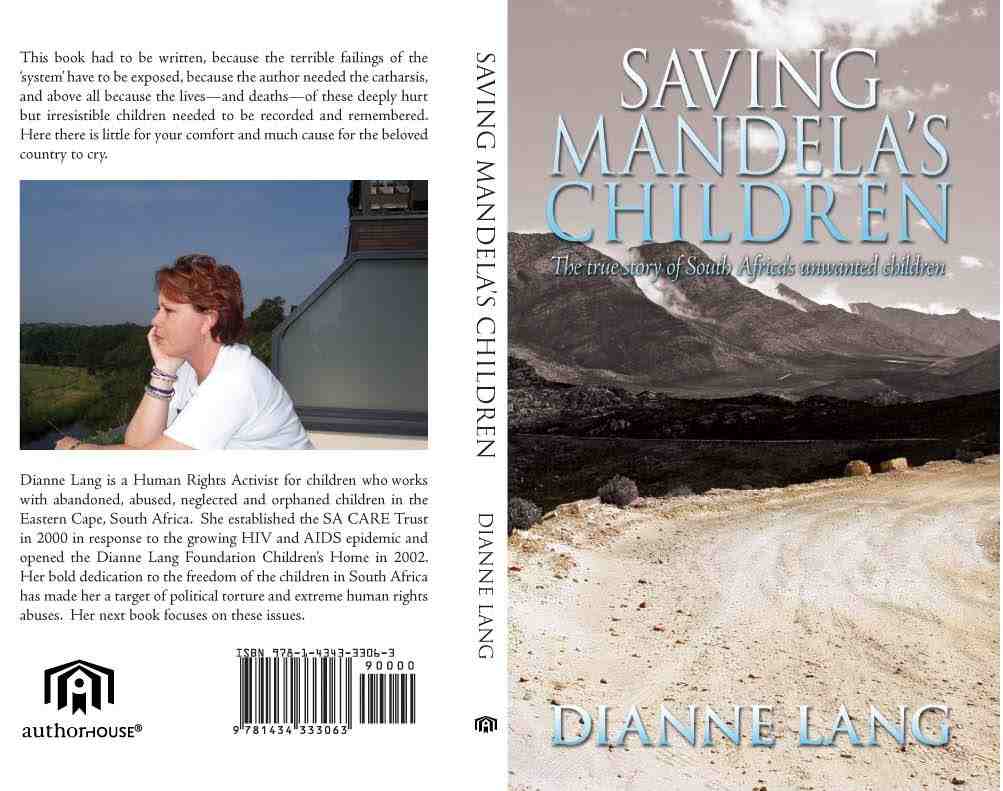
(Extract from Saving Mandela’s Children by Dianne Lang - available on Amazon and Kindle)