Thursday, December 3, 2015

Saving Children is an Exercise in Futility if the Child Care Act is not used by Social Workers and Commissioners of Child Welfar

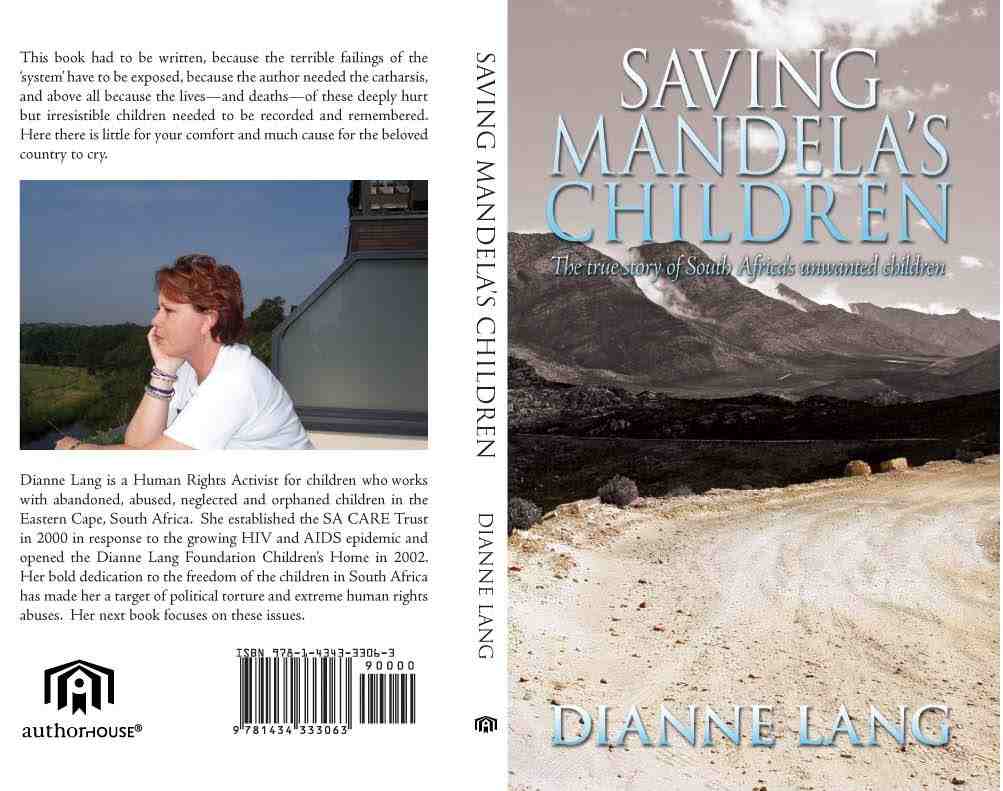
Book available from dianne.lang1@gmail.com or on Kindle
20 December 2006

A typical example of how the Social worker and Commissioner of Child Welfare ignore the Child Care Act 

After years of fighting for children’s rights, particularly to ensure that Section 28 of the Constitution is adhered to by the officials responsible for children in our country, Dianne Lang is still battling and losing the fight for children’s interest to be taken into account on the very first levels of service.

On 16 December 2007, The Dianne Lang Children’s Home Supervisor, Diana Jagers, was telephoned by Sister Essex of the Wilhelm Stahl Hospital in Middelburg at 3pm to say that an abandoned baby had been brought in by the police.  The hospital had no place for the baby and that they had been instructed by the Senior Social Worker, Mr Johan Pienaar, of the Department of Social Development, to telephone the Children’s Home to care for the child until Tuesday, 18th December 2007.

The baby girl, aged 5 months, was brought to the Children’s Home by Police Officer SI Ngubentombi, who had also been instructed to bring the child to the home by Mr Pienaar.  The police officer stated that the baby had been brought to the police station by her father who was under the influence of alcohol.  The father stated that he was unable to care for the child and that the whereabouts of the mother were unknown.   They had been living on a farm and he had brought the baby into town after he could not find the mother anywhere.

The Children’s Home may not take any child into care without a Form 4 signed either by a social worker, a police officer or an officer of the court.  Diana Jagers attempted to contact Johan Pienaar and Pumza Mobo, both social workers of the Department of Social Development, but was unsuccessful in reaching them.   Police Officer SI Ngubentomi then completed and signed the Form 4. 

Hasty arrangements were made to have a supermarket opened on a Sunday afternoon to purchase bottles, nappies and baby formulae. 

On Sunday evening, 16th December 2007, the father of the baby arrived to tell Diana Jagers that he had found the mother in one of the townships of Middelburg.  The mother was also under the influence of alcohol.  She told him that both of them were to accompany her to the Commissioner of Child Welfare on Tuesday morning as she could not hand the child to them in the condition they were in and that the child has been placed in her care until Tuesday.  

On Tuesday, 18 December 2007, Diana Jagers, took the baby, Asemahle van der Berg and a staff member Emmanuel Moyana to the court.  The parents of Asemale were there.  This is the procedure according to the Child Care Act.  Diana Jagers phoned Johan Pienaar and told him that she was at court and he informed her that the procedure was correct and that the Commissioner would inform the social workers what to do.

After waiting for more than an hour, Diana Jagers was informed that the Commissioner of Child Welfare was on leave and that Mr Mata would stand in as Commissioner.  She requested to see him at once.  She explained the reason she was there and he told her to hand the Form 4 to the Clerk of the Court to open a case file.  He would then review the file and make a judgement.   The Clerk of the Court told her that she would contact Diana as soon as Mr Mata had signed the Form 5 granting a 2 week extension for investigation.

At noon, the Clerk of the Court contacted Diana Jagers to say that Mr Mata was not going to grant an order because the social worker had not signed the Form 4 and that there was no social worker’s report.  Diana then took the Form 4 to Johan Pienaar, who looked at the Form, wrote that the case had been referred to his department on it, and told Diana to return it to the Clerk of the Court, which she did.

At 17h00, Pumza Mobo, another Department of Social Development social worker came to the children’s home to interview the mother and father.  She said that Mr Mata had instructed her to do an investigation before he could make a ruling.  She wrote down some notes and phoned Mr Mata.  He told her to come to him.

At 18h00, Pumza Mobo arrived back at the Children’s Home with a hand written note from Mr Mata on a blank piece of paper, stating that the baby was to be handed back to the mother.   This was not a court order, but a note written on a piece of paper.

The correct procedure is for the magistrate (Commissioner of Child Welfare) to bring the parents, the child and their legal representatives to court.    The commissioner is supposed to allow the social worker to read his or her report under oath.  Further witnesses may be called on behalf of the state (the policeman and the hospital staff) where after the parents will be given an opportunity to present their evidence. 

Parties have the right to know what is in the social worker’s report.

If a social worker has not been able to do a report in time, a Form 5 is issued for a 2 week period, during which time, the social worker is given time to do a thorough investigation of the circumstances of the child.   Please note that the social workers were aware of this abandoned baby for a number of days before it came before the Commissioner of Child Welfare but since it was a long weekend ….

None of this happened.

The report of the social worker consisted of a few questions put to the parents and her reporting back to the magistrate via a telephone conversation.   When the Social Worker went back to the Commissioner of Welfare, it could not have been to court, otherwise the letter would have been a court order.  The court order was collected by Diana Jagers from the Clerk of the Court on 20th December 2007, date stamped 20/12/07, two days AFTER the removal of the child.

The reason given on the Court Order returning the baby to the parents states:  ‘They did not appear in Court.  They gave explanation to the social worker P Mobo about what happened’.

Our Constitution and Child Care Act only means something if it is implemented correctly.   When the Department of Social Development send memos to NGO’s working with children to attend updates of the amendment of the Children’s Bill, when they themselves do not have any idea of how to implement the current Child Care Act or Constitution, it would be laughable if it were not so tragic.  Needless to say, these meetings are cancelled at the last minute, when NGO’s fail to hear where the venue is to be held.

I never wanted to be an activist for Children’s Rights.  I was happy to just take care of those abandoned, abused, neglected and orphaned children.  You, the Department of Social Development, turned me into a political activist, when you wanted to remove the children from me and put them back on the street, where they would die of hunger, hypothermia, abuse and AIDS.

I would not have had to take on this job, if you had been doing something about our children. 

How do the Department of Social Development see me?  Do they see me as an interfering body that just shows them up?  Do they not see the good in our project, the determination and motivation to make a difference to the lives of the children of SA so that we have a future that is good?   Is it just easier to criticise, condemn and denounce those who want to make a difference?  Have I shown people how uncompassionate our society is and how uncaring our officials in the DOSD are? 

It is a crying shame that the world does not see how it really is for our children.  It is a disgrace that our President, Ministers and our Members of the Executive Council do not see this, do not respond to our letters, our telephone calls, our complaints and do nothing about it other than to continue to allow their personnel to persecute those who are caring for the children.

What kind of a future do we have when we do not care for our children and when we give our abandoned babies back to drunken parents without finding out from the witnesses what happened, because a five month old baby cannot speak for herself?  How tragic that the best interests of the child is so easily swept aside.


Dianne Lang © 2008

Wednesday, December 2, 2015

Remembering Luke


Luke came to us when he was approx. 9 months old.  He had full blown AIDS and weighed only 3.2kg.   His prognosis was very poor and he was not expected to live longer than a week or so.  Luke was with us for 9 months and Amore took over his complete care.  He needed someone 24/7 and Amore did that for him.   When he died, we were all terribly sad, even though we had been expecting it - one always lives with the hope that things will turn out differently.   Even though he was a very sick little boy, he had quite a personality with a very strong will.   He knew what he wanted when he wanted it.   He never did learn to crawl or walk - although he did learn to sit on his own, hold his own bottle and eat biscuits on his own.  Luke took a long time to die - he struggled to breath for over 18 hours.   His little heart was beating rapidly and hard and he struggled to take a breath.  His eyes were looking up and to his right all the time, as though he was watching someone or something.   When we called his name, he would turn his eyes back to us, so he knew we were there with him.  It was heartrending to watch.  And then he just stopped breathing.   Just like that - he just stopped.  We could not believe it - after all those hours of holding him and trying to breathe for him. 
Burying Luke was another trauma.   A burial order had to be obtained from the police who would not release the order without a funeral parlor being involved and the least expensive funeral parlor was over R1800,00 for the funeral.   We wanted to bury Luke ourselves, without all the paraphernalia that goes with funerals.   It was a fight to get the burial order (eventually got someone just to sign it so we could go ahead with the funeral).   Then, the death certificate had to be obtained from the next town, Cradock, which is 100 km away.  Armed with the burial order, we went to the municipality to buy a plot at the cemetery.   I was asked what color the baby was because a black baby could not be buried in a "white" cemetery.   That too was another fight - seems that nothing much has changed in the small times in the 10 years since apartheid was blown out the water.   We made history - Luke was the first black person to be buried in the "white" cemetery.
Then we had to dig the grave, which had been marked out for us.   Because the ground one foot down becomes so hard, we had to use a pick.   But an adult could not fit into the grave with a pick, so the children had to take in turns digging in the grave.  Eventually we were using old jam tins.  And down came the rain - digging under a piece of plastic and then the sun came out.   Jumping in and out the grave, covering it with plastic, rain then sun, and on top of that, people stopping and shouting at us wanting to know what we blacks were doing in the cemetery and whether we had paid for the plot - it was quite an accomplishment to finish digging the grave.   

We bought a little coffin that was obviously a reject, but it only cost us R180,00.   All the children got a turn to paint the coffin and draw or paint pictures on it.   We carried the coffin to the church (walking) and then we walked to the cemetery.   Amore and I still miss Luke. 

Someone was to blame for Jonathan Kaptein's suicide - and got away with it.

The funeral of Jonathan Kaptein   
Someone is to blame for boy’s suicide, says town’s heroine
Abused lad taken from her loving home
By Helga van Staaden and Lauren Cohen (22/02/2015)

The social welfare system failed a 14-year-old-boy who committed suicide at a place of safety earlier this month, says a community worker who cared for him for months before he died.   Dianne lang was devastated to hear about the death two weeks ago of her former charge, Jonathan Kaptein, at the Erica Place of Safety.
Lang recently returned from Johannesburg after receiving an award sponsored by the women’s magazine FairLady and cosmetics giant Clarins for her community work in Middelburg, where she looks after more than 60 street children.
She said social workers did not always act in the interest of children, but instead “shuffled paper” trying to find the easiest solution to the problem.
“Somebody must be held accountable for Jonathan’s death.  There needs to be an inquiry, ”said Lang.
Jonathan was already dead when staff members found him with a shoe lace around his neck at 7.15pm on February 10.  He had absconded from the facility the previous night.
It is alleged that a group of Jonathan’s peers forced him to take the rap for a stash of dagga seized at the home.  Before his death Jonathan used the back of a spoon to carve into cement a note reading “The dagga is not mine”.
It is alleged that Jonathan that alleged that a group of Jonathan’s peeers forced him to take the rap for a stash of dagga seized at the home.  Before his death Jonathan used the back of a spoon to carve into cement a note reading “The dagga is not mine.”
It is alleged that Jonathan was constantly bullied by older boys, who tried to force him to take the rap for the dagga.  After the inscription was photographed by the police, it was scraped off in an attempt to “wipe the writing off the wall”.
Jonathan, and his best friend, Lionel Cox, 15 had been in Lang’s care since December 2003 until social workers removed them in March last year and placed them at the Erica Place of Safety.
At the time social workers alleged that the boys were sexually molested by an employee at lan’gs facility, a claim Lang denies.  A criminal case was opened but no charges were ever pursued against the employee. 
Lang said she found it strange that only the two boys were taken from her and none of the other children. She did not believe Jonathan committed suicide because of drugs.  She said shortly after the boys were placed at Erica, they were tattooed against their will by other boys.   They also complained of sexual advances.  In letters the boys told her how unhappy they were at the facility.
Lang said identifying Jonathan’s body was “horrendous”.  “I am sad but I remember Jonathan as the life and soul of the party.  When he walked into a room, the whole place lit up.  He used to fill the room with energy.  He was such a loveable boy” said Lang.
Lang said she was tired of fighting on her own and needed people to help.
“I am sad.  Being angry is a waste of time.  I am sad because of the potential we lost.  As difficult as it is, I will have to find a way to do it”, she said.
Social development spokesman Gcobani Maxwana yesterday said the department had received a report from Erica Place of Safety.  It has been forwarded to the department’s superintendent general.
“We need to get all the facts together and we cannot make our own conclusion.” Said Maswana.
M-Net’s actuality programme Carte Blanche broadcast Lang’s story last week after she received the Clarins/FairLady award for her work to improve the lives of abused and abandoned children in the impoverished Karoo town.
The prize rewards women working to help and heal South Africa’s neglected children.
Lang was chosen ahead of 120 nominees to receive the award and R150 000 prize money which will help her continue her work caring for more than 50 children who have been ill-treated or abandoned.
She sold her home in PE in 2002 and moved to Middelburg to provide children with food, shelter, education and love.
“I started with three children who had been living in a chicken coop and was soon faced with more and more cases of abuse and trauma which I could not neglect” she said.  “I never set out to get any award, I wish the children had been recognised and not me”.

Read more about her work by purchasing “Saving Mandela’s Children”, which is available on Kindle, Amazon and for South African’s from http://megabooks.co.za/shop/saving-mandelas-children/  

To save on packaging and posting, the book is also available from Dianne. (dianne.lang1@gmail.com

Wednesday, November 25, 2015

People with Rare Diseases need Understanding from those around them

Society needs a new platform of understanding of rare diseases. 
People with rare diseases often end up being the expert in their particular disease, but it is a very lonely road to travel. And most doctors do not like what they call “google patients”.  But with a rare disease, how can we not become detectives of our own illnesses, constantly hoping that there is a cure out there for us or even finding a cure ourselves through our research.  Just maybe a new look with ignorant eyes can see something that would be easily overlooked by the researchers.   The difference between people’s responses to me when I tell them about not having an immune system and telling them about the breast cancer is like chalk and cheese.  While you can’t see either illness from the outside, almost everyone without fail reacted with compassion and understanding to the breast cancer.  They do not even look at me when I spoke about my absent immune system.  I can see in their faces that they either don’t want to know or they think that I must have AIDS (oh, what skande) because AIDS has something to do with immune systems.   Rare illnesses also deserve to have the same platform of understanding.

To all those who have a rare disease – you have my immense respect.  It isn’t easy to paddle alone in a canoe.   When we hit the rapids all we can do is hold on.  Tomorrow the river may flow more gently, and we may have the energy to be grateful that we made it through to another day…one that holds the possibility of beautiful and magical moments.     

So what the fuck is wrong with her anyway?

Sister Lulama 
I have been asked via FaceBook inbox a number of times what exactly is wrong with me.   So here it is.  I am crazy but I like that part of me. Secondly, the only part of my body that seems to work well is my heart - it is filled with love and is just like a South African taxi... there is always room for one more person. Seriously, here are my diagnoses. 
Hairy Cell Leukaemia (a very rare leukaemia where only one person per 3.2 million people are diagnosed per year). I have had three rounds of chemotherapy for this and still have MRD (Minimal Residual Disease) This one is not really such a problem for me, although it did metastasise to breast cancer which ended up with me being tit-less. 
Leukocytoclastic Vasculitis (why I have a permanent port in my chest for infusions as all my peripheral veins have collapsed)
Hypogammaglobulinemia: This is a big problem. Because I have Primary Mannose-binding Lectin Deficiency and Secondary Humeral Immune Deficiency, it means that I do not have an immune system. There are no building blocks to even jump start the immune. And there is no cure. Having no immune system makes me vulnerable to any virus, bacteria or allergy and this is what puts me on my back and in hospital time and time again. Hypogammaglobulinemia is so unpredictable that I can’t make plans for later today, never mind for some time next week.  I live in a sterile bedroom and the only place I go other than my bedroom and bathroom, is to hospital. Even when I am there, I am vulnerable to any germ so I am put into isolation and barrier nursed. That means red bags for incineration, yellow bags for autoclaving and everyone who comes into the room is dressed up in theatre gowns, masks, boots, headgear and gloves. I have to have IVIG which is an immune system collected from donated blood and is transfused into me every second week. This gives me a kind of temporary immune system, but it is used up within two weeks so I have to go and get it again. It is a moerse big deal thing because it can cause all kinds of problems from anaphylaxis to host vs graft disease. Every time I go there is a possibility that I won’t come home. And if I do come home, I have to contend with the side effects of the IVIG. So I stare death in the face every second week – but without this infusion I will not live longer than an estimated six weeks. Blood donors keep me alive!
Another little problem that I have is that my kidneys are not functioning properly – but we are not near the stage of dialysis yet. These are just the names of the things that are wrong with me and I have not stated the symptoms of them – all I can say is that they are horrid and I would not wish these symptoms on my worst enemy, not even on Robert Mugabe and he truly is my worst enemy.  I can go from full steam ahead to dead stop in in less than half an hour. I don’t know why I do not get well and I do not die. It is what it is. Lots of people tell me that I am still alive because God still has stuff for me to do, but I do think He could be a little more kind to me. Every time my loved ones and my dearest FB friends think that this time I am a gonner, I seem to make it round the final bend; on wobbly legs and I totter down the main straight to be back amongst the living again…humorous, laughing with joy in the face of death once more. But each time it is a bit harder, and each time I am a bit weaker and each time a little of me has been left behind. And each time, I struggle harder to do the little things I used to be able to do before the last crisis.   Because I have all these rare diseases, does not mean that I am not still a human being. I am still me. I am just a prisoner of this body. I still worry about finances, how I can find the energy to clean the house or sometimes even to make a cup of tea and I worry about those I love, the state of our country, work, home life, my family and friends.  And I still want to be part of life – the part of life that only family and friends can give me by calling on the phone or visiting me.   My whole world has changed and normal no longer applies to me.  My new normal is feeling shitty.  And because I feel nauseous and ill so often, I get grumpy and unreasonable.  Could you love me through that?  

Tuesday, November 24, 2015

UNFRAMING HEINRICH VAN ROOYEN

There is a little seaside village called Knysna.  The only real income to keep the village going during out of season is the huge amount being spent by visitors and tourists to the village during the holidays; and in particular, during the Christmas holidays which usually covers six weeks.
The clubs and bars hum with business and the chink-chink of the cash registers. Booze is selling very well.  Everyone is happy.   At one of the night venues is a beautiful looking DJ who is always smiling.  He becomes the target of every young girl’s dreams.  To be seen hanging on his arm, or standing behind the turn-tables with this good-looking young fellow creates a competition between the young women.  He in turn reciprocates – they want to make love, he makes love.  What young man would turn away from beautifully shaped, stunning looking young women?

Suddenly, the holiday feeling and the peace of the village is shattered when a young girl is murdered and a month later, another is murdered.

The police are under tremendous pressure to put the murderer behind bars.  They are being pressured by all the businesses.  “People will stop coming for the holidays” the business owners scream.    A third person is murdered, but that person hardly features in the gossip and the speculation going around the town.  The murder of the girls is on everyone’s lips.

Meanwhile, earlier in the year, March 2005, Inge Lotz is brutally murdered in her Stellenbosch apartment.  The police are also under pressure to find and convict her murderer. They settle on her boyfriend, Fred van der Vyver who was arrested.  However, the Western Cape High Court acquitted him.  He was innocent.   The murderer is still at large ten years later.

Why am I discussing the murder of Inge Lotz when the subject of this article is Knysna and a good-looking DJ.   Wait … the reason will become evident.  Let us set aside the Stellenbosch murder for the moment.

In October 2005, Jessica Wheeler was found murdered in the church yard in Knysna.  The police were unable to identify a clear suspect and no arrests were made.  In November 2005 (just before the Christmas influx of tourists and holiday makers), Victoria Stadler was found murdered at the Noetzie forest at Knysna.   Both girls socialized at the same nightclubs, one being “Stones”, where the popular young DJ worked his magic with his music.

The third person murdered and seldom spoken about was Peter McHelm.  He was found on the same day and in the same vicinity as Victoria Stadler.  Aubrey Kamoeti and Byron Moses were arrested, charged and found guilty of the murder of Peter McHelm.   This is a glaringly obvious anomaly – why were these two people found guilty of the murder of Peter McHelm but not of Victoria Stadler?  It does not take a rocket scientist to realize that there is a huge problem here that was not addressed by the police. It is not logical for two people to kill Peter McHelm, but for someone else to come along and kill Victoria at the same time and in the same place.  One has to be a complete idiot to believe that.

Director A Trollip of the SAPS, Christhenus van der Vijver, the public prosecutor, and Superintendent S Otto from the SAPS forensics  were all involved in both the Lotz murder (where the accused was acquitted) and the Knysna murders.   Why did Director A Trollip and his team have to come from the Western Cape to Knysna, weeks after the murder and suddenly they had a suspect?  Why was the forensics negative until Director Trollip arrived, when suddenly they became positive?  The DJ was framed!  That good-looking, fun-loving Heinrich van Rooyen was found guilty of the murder of both girls, and sentenced to 30 years imprisonment without option of parole.  Leave to appeal was denied.

He has now been in prison for ten years.   His parents have sent 1.2 million rand on his defence.  Once the money ran out … who cared if one young man was put away for life?

We care and we will do whatever it takes to right this miscarriage of justice.  The murderer of Jessica Wheeler is still at large.  It is common knowledge that the murder of Victoria Stadler was committed by the same people who murdered Peter McHelm.


There has been no justice for Jessica Wheeler and no justice for Heinrich van Rooyen.   Let us all work hard to right a wrong.  Let us fight injustice with every ounce of our strength and with every breath we take.   “For what you do to the least of my brothers, you do unto me”. 

Monday, November 23, 2015

The Monster in my Life

It is the coldest, darkest part of the night; the time just before the birds let you know that dawn is arriving – that I am rudely pulled away from my gentle slumber by the monster.  The monster’s name is Mr Naar Vomitus.
Oh, the longing to get away from Mr Vomitus. 

Pain one can handle; you can scream or you can hurt yourself where you have no pain to focus the pain on someplace else.  But with Mr Vomitus, there is nowhere to go.  You can’t get rid of him once he has you by the throat.  It is war – all-out war.  I throw all my ammo at him; it weakens him but he comes back time and again and suddenly – relief…reprieve from heaven.  Mr Vomitus is no more.  This is the way I start my day, every day.  This is how I win the first fight of the day.